
Your QBank Score Is Not the Whole Story
The number matters, but the pattern behind missed questions is what tells a candidate what to do tomorrow.
The Short Answer
An img or medical exam candidate using question banks does not need another impressive demo as much as a workflow that survives real use. A candidate finishes a block with a decent score but keeps missing questions that require the same reasoning step. The score comforts them; the pattern would help them improve. The practical answer is to make the tool narrow, visible, and accountable: one problem, one anatomy focus, one next action.
AI exam-prep tools are becoming more common, so candidates need systems that reduce false confidence instead of adding more explanations. That is why AI medical QBank prep is less about novelty and more about disciplined use. A tool that feels magical for two minutes can still fail the reader if it leaves no trail for review, teaching, or decision-making.
The Moment The Problem Shows Up
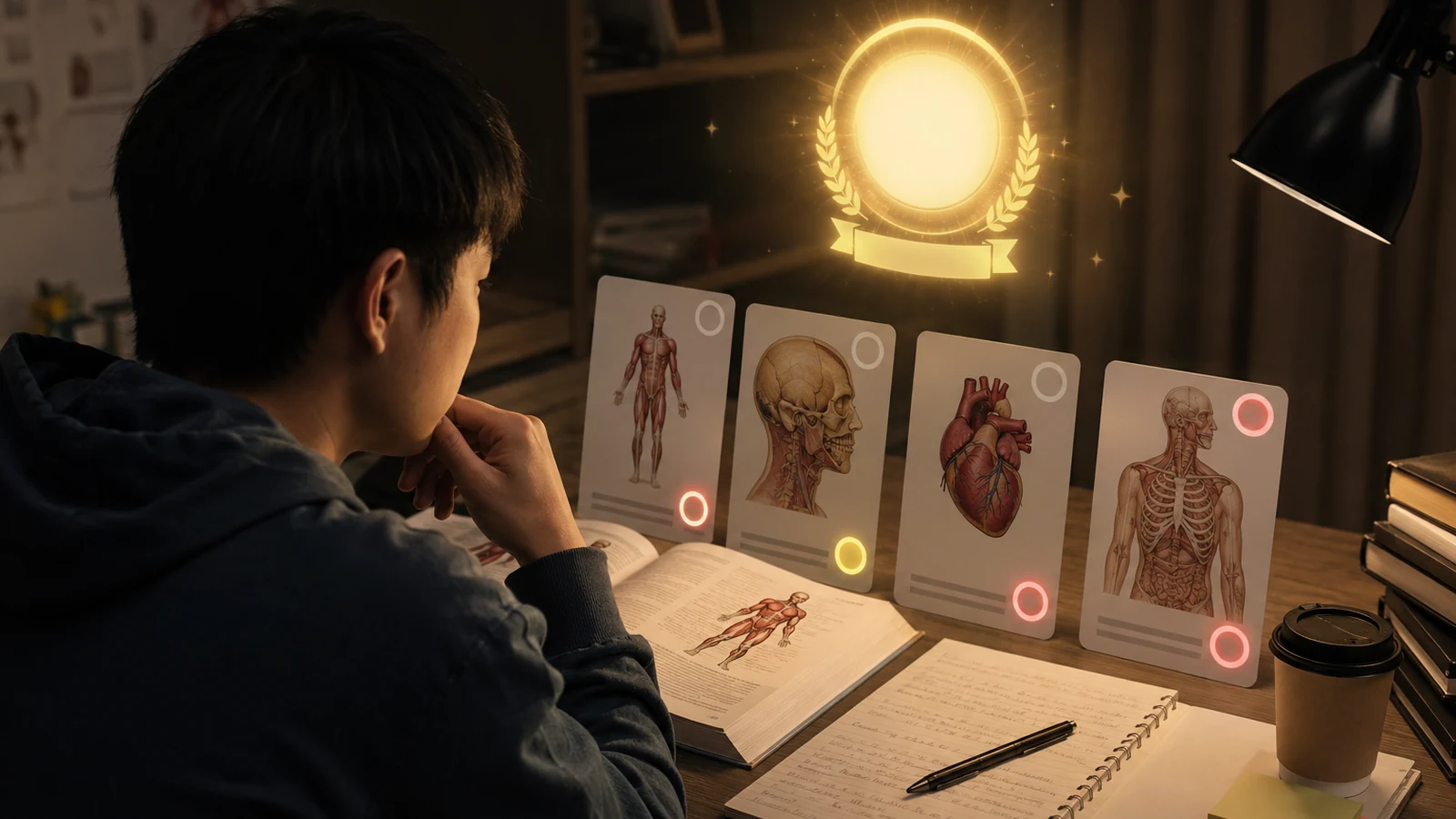
A candidate finishes a block with a decent score but keeps missing questions that require the same reasoning step. The score comforts them; the pattern would help them improve. This is the point where the work becomes concrete. The reader is not asking whether technology is exciting. They are asking whether it can protect time, clarity, trust, and follow-through when the setting is busy.
A useful article on this topic has to stay close to that lived situation. For adjacent context, MeduTechs keeps related resources for this audience in student-focused anatomy articles, which is useful when the reader wants the broader audience path rather than a single product claim.
The Hidden Risk
The common mistake is simple: Reviewing missed questions one by one without asking what the misses have in common. It sounds harmless because the first result may look cleaner than the older workflow. But in medical education and clinical explanation, clean is not the same as trustworthy. The tool has to make the learner, faculty member, clinician, or partner better at the task, not merely more impressed by the interface.
The risk is especially sharp when the user loses the chain of reasoning. If a student cannot explain why a structure matters, if a professor cannot see the source of an AI-supported note, if a clinician cannot keep the conversation patient-centered, or if an investor cannot tell where trust comes from, the workflow is still unfinished.
A Practical Framework
Use a five-part check: Group misses, Name the pattern, Rebuild the concept, Test the variation, Schedule the repair. The words change by audience, but the logic stays steady. First, name the task. Second, choose the smallest useful anatomy focus. Third, decide who controls the explanation. Fourth, make the next action visible. Fifth, review whether the tool improved the human workflow.
This framework keeps the article from sliding into tool worship. It asks whether the technology helped the reader do the job with more clarity. That is also why the related MeduTechs article AI Medical QBank Prep Should Show Your Weakest Pattern matters here: it continues the same practical problem from a previously published angle instead of treating this article as an isolated claim.

Where Quiz Maker (MAIQ) Becomes Useful
This is where Quiz Maker (MAIQ) can fit without taking over the article. Its primary feature for this piece is weakness pattern analytics: a MAIQ feature that groups missed questions into recurring weakness patterns so the learner can plan the next study session instead of staring only at a score. The useful part is not that MeduTechs appears in the workflow. The useful part is that the workflow becomes more controlled, more visual, and easier to repeat.
For exam-prep candidates and IMGs, that matters because the same technology has to serve a specific moment. It has to help an IMG or medical exam candidate using question banks move from uncertainty to a next step. When the reader is ready to see the MeduTechs path in context, Explore MAIQ through MeduTechs is the cleanest next step.
What Good Use Looks Like
Good use is deliberately small. Start with the question the reader actually has. Pick the anatomy structure or learning decision that matters now. Use the visual layer or AI support to clarify that point, then ask the user to act: recall, explain, compare, teach back, pilot, review, or decide.
In practice, this means the tool should reduce friction without reducing responsibility. A student still has to retrieve. A professor still owns the teaching logic. A doctor still leads the conversation. A clinic still protects patient understanding. An investor still has to test whether the company has a real trust advantage.
The Workflow In A Real Day
Imagine the same idea inside a normal day, not a staged demo. An img or medical exam candidate using question banks has limited attention, competing priorities, and a real consequence if the tool creates false confidence. The best workflow begins before the screen appears: what is the exact question, what anatomy structure matters, who needs to trust the answer, and what should happen after the explanation?
For exam-prep candidates and IMGs, the answer should be concrete enough to audit. If the article is about learning, the learner should be able to recall and explain the structure without staring at the answer. If the article is about teaching, faculty should be able to see how the tool supports the lesson. If the article is about clinics or doctors, the patient conversation should remain human and clear. If the article is about investment or partnership, the value should be repeatable, not dependent on a beautiful first demo.
The Checklist Before Adoption
Before adopting any tool around AI medical QBank prep, ask five plain questions. Does the workflow make the user's job easier to do well? Does it keep the anatomy visible instead of burying it behind generic explanation? Does it show where human oversight belongs? Does it make the next step obvious? Does it avoid claims that the product cannot responsibly support?
This checklist is intentionally unglamorous. It protects the reader from the most common failure pattern in medical education technology: a tool creates energy during introduction, then loses usefulness when the real routine arrives. MeduTechs should pass the harder test. Quiz Maker (MAIQ) and weakness pattern analytics should help the reader do one important thing with more clarity, and then leave a trail that can be reviewed, taught, repeated, or improved.
What To Measure First
The first measurement should be modest. Do not begin with broad claims about outcomes, intelligence, or transformation. Begin with behavior. Did the user complete the intended step? Did the anatomy remain understandable? Did the workflow reduce avoidable explanation time, study drift, faculty burden, or implementation confusion? Did the person using the tool know what to do next without being pushed into a sales path?
That measurement mindset keeps the work credible. It also makes the product easier to improve. A narrow metric can reveal where the workflow breaks: the prompt is too broad, the visual is too busy, the learner skipped recall, the faculty rule is missing, or the consultation became screen-first. Once that break is visible, the team can repair the workflow instead of adding another feature on top of it.
The Editorial Test
Before publishing, the article should pass one human test: would an IMG or medical exam candidate using question banks recognize the pressure described here and leave with a sharper decision? If yes, the content is doing useful work. If not, it is only describing a category.
A Better Next Step
A stronger next step is not a bigger feature list. It is a cleaner workflow. Ask: what would the reader do differently tomorrow after using the tool? If the answer is vague, the implementation is not ready. If the answer is concrete, the tool has a chance to become part of the real routine.
The earlier MeduTechs guide AI Medical QBank vs Chatbot Study Loop is a useful continuation when the reader wants another concrete example from the same ecosystem. The link belongs here because the problem is no longer abstract; the reader is deciding what better practice looks like.

The Memorable Insight
The memorable insight is this: in medical education, the best AI or 3D anatomy layer is not the one that gives the most impressive answer. It is the one that makes the next human action clearer. That action may be a student recalling a structure, a professor correcting a misconception, a clinician checking understanding, a partner standardizing a station, or an investor asking the right diligence question.
That is why your qbank score is not the whole story is a practical issue, not only a technology issue. The reader should leave with a way to judge the workflow before judging the promise.
Sources And Further Reading
- AAMC Principles for Responsible Artificial Intelligence in Medical Education - AAMC AI in Medical Education - FDA Artificial Intelligence and Machine Learning in Software as a Medical Device - OpenAI Health
Conclusion
The strongest path is not to ask whether AI medical QBank prep sounds advanced. Ask whether it helps the right person complete the right task with more clarity and less drift. That is the standard MeduTechs should meet in public content and in product design.
For exam-prep candidates and IMGs, the next move is to test the workflow in a real setting, with one app, one feature, and one measurable next action. Explore MAIQ through MeduTechs when the article's problem matches the reader's current workflow.

Continue reading
Frequently asked questions
References
- AAMC Principles for Responsible Artificial Intelligence in Medical EducationTrust A- Medical schools need governance, transparency, human oversight, and educational integrity when adopting AI.
- AAMC AI in Medical EducationTrust A- AI is becoming a medical education priority that requires faculty and institutional planning.
- FDA Artificial Intelligence and Machine Learning in Software as a Medical DeviceTrust A- Clinical AI claims require careful boundaries and should not be overstated in educational or patient-facing content.
- OpenAI HealthTrust A- AI health workflows are expanding, making trust, context, and human oversight important in medical contexts.