
AI Medical QBank or Chatbot? The Study Loop That Reduces False Confidence
Exam prep gets dangerous when your study tools make you feel ready faster than they make you ready. That is why some students spend weeks with AI explanations, high motivation, and tidy notes, then get blindsided when timed questions expose weak recall or sloppy reasoning.
The issue is not that chatbots are useless. The issue is that they are often too smooth. They help you understand after the fact, but they do not always tell you whether you could have produced the answer under pressure.
For high-stakes exams, that distinction is expensive. A study method can feel efficient for weeks and still hide the exact weakness the exam will punish: slow recall, poor distractor control, shaky management logic, or a collapse in confidence once the timer starts.
The core difference between a chatbot and a QBank
A chatbot is built to respond. A QBank is built to reveal.
That difference matters because high-stakes medical exams care less about whether a concept seems familiar and more about whether you can retrieve and apply it under constraints. Retrieval-practice research keeps reinforcing the same principle: pulling the answer out is a different cognitive job from recognizing it after an explanation.
That difference is even harsher for IMGs and students crossing into a new exam format. The content challenge often sits on top of timing pressure, language load, and unfamiliar distractor design. A tool that feels supportive but never measures those pressures can still leave you exposed.
This is why a chatbot and a QBank should not be asked to do the same job. A chatbot can help you understand a concept. A QBank tells you whether you can use it when the stem is messy, the distractors are close, and the clock keeps moving.
That is also why many strong students still underperform when they rely too heavily on explanation-first prep. They understand the logic when it is presented calmly, but they have not trained the exact retrieval conditions the exam requires.
Why false confidence grows so easily
Smooth study sessions feel productive. That is exactly the problem.
When an AI tool answers quickly, fills the gaps, and explains every distractor, you can leave the session thinking, “I know this now.” But what you may actually know is how to agree with a good explanation.
A recent study linking search-supported diagnostic work with self-confidence is useful here. Confidence can move faster than competence when the answer environment is too easy.
That is why some candidates feel strongest after their most comfortable study days and weakest after their hardest review blocks. Comfort and readiness are not the same metric.
If your prep tool mainly leaves you calmer, that can be emotionally useful, but it is not yet enough. Good prep needs to create a performance signal you can trust even when it bruises your confidence for a day.

A better study loop for AI-era exam prep
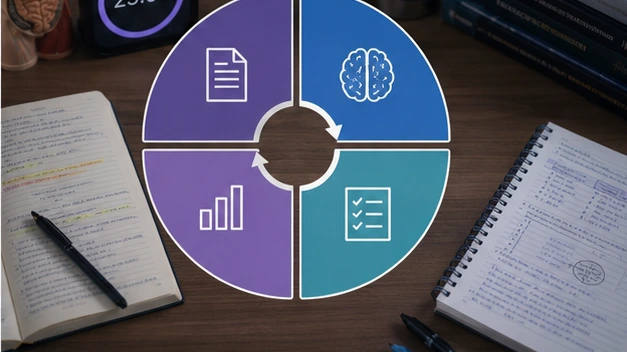
1. Simulate first
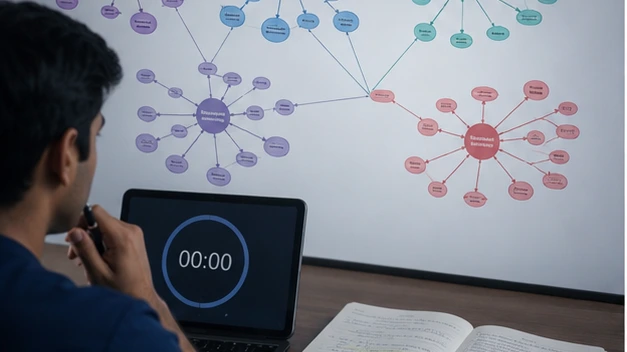
Start with timed, unanswered practice where you do not get immediate rescue. You need an honest signal before you need comfort.
2. Diagnose the misses
Look for pattern, not just score. Did you miss because of recall failure, distractor confusion, poor stem parsing, or weak management logic?
3. Explain narrowly
Now use AI or guided explanation to repair one weakness at a time. Broad review is less useful than precise correction.
4. Re-test under pressure
Come back to a similar problem without hints. If the error survives, the explanation did not stick.
The common mistake: using AI before you know what is broken
Students often turn to AI too early. They review a topic generically, feel productive, and only later discover that their real weakness was timing, distractor discipline, or inability to retrieve under pressure.
That is why question-first loops matter. They give you a map of your errors before explanation begins.
Without that map, you may waste a week “reviewing cardiology” when the real issue is narrower: maybe your endocrine timing is poor, maybe your distractor discipline collapses late in a block, or maybe you consistently miss next-best-step wording.
That is also why generic topic review is overrated late in prep. Most candidates do not need “more everything.” They need sharper visibility into the small set of mistake patterns that keeps repeating.
This is where a weakness loop becomes more powerful than a motivation loop. Once you know the pattern, you can change the next block on purpose instead of studying whatever feels urgent.
Where MAIQ becomes practical
This is where MAIQ fits naturally. The feature that matters most is not endless content generation. It is Simulation Mode, because simulation changes the honesty of the study signal.
Once you have that signal, supporting tools like weakness analytics or targeted follow-up questions become useful. Without the signal, they are just extra polish.
That is why a structured QBank loop often feels less emotionally pleasant at first. It is telling you something true before it tries to make you feel better.
That is also where weakness analytics becomes more than a dashboard idea. It turns vague frustration into a pattern: maybe you are misreading qualifiers, maybe your pharmacology recall drops after forty minutes, or maybe you keep losing points on questions where you know the mechanism but miss the management step. Once the pattern is visible, the next revision block can finally be specific.
That specificity is where exam-prep products either become useful or decorative. If the tool cannot help you see exactly what keeps going wrong, it will keep making broad promises while your score stalls.
The MeduTechs student audience page is still the most relevant exact internal link available for this lane because the underlying reader problem is learner readiness, not procurement.
The contextual CTA is simple: if your prep feels good but your performance still swings, change the order of your loop. Test first, then explain.
A daily routine that keeps false confidence lower
One workable routine is:
- one short simulation block - one weakness review block - one explanation block - one retest block
That order matters. It forces the performance signal to lead the day instead of your mood.
Across a longer prep cycle, the same principle should shape the week. Run one longer simulation, review the miss patterns, repair only the repeated weak spots, then test again on fresh questions. If the same error family survives three cycles, your method needs changing, not your motivation speech.
For IMGs or candidates switching exam systems, an extra layer helps: keep a short note on whether the miss came from content knowledge, exam language, or rule-out logic. That separates “I do not know this” from “I know this but I did not process the question cleanly enough.”
Another useful discipline is to protect one no-explanation block each week. Do a set where you are not allowed to open the chatbot between questions. That keeps you honest about whether your current reasoning can survive without immediate reassurance.
Over time, that kind of protected pressure makes later explanation more valuable because you finally know what you are trying to repair.
The memorable insight
Helpful is not the same as diagnostic. If a tool mostly feels good, it may still be hiding the exact weakness your exam will punish.
That is the real reason to prefer a better loop over a nicer explanation. Good prep is not just informative. It is honest.
And honest prep usually feels less magical in the moment. It feels more like a mirror, which is exactly why it works.
Candidates rarely love that feeling in the short term. They usually trust it more once the scores start becoming steadier.
And steadier performance is what matters on exam day. Readiness has to survive pressure, not just reflection. That is the whole point of the loop.
Sources and further reading
- PubMed, “Comparing different retrieval practice strategies using virtual patients” (2026) - PubMed, “Student-directed retrieval practice is a predictor of medical licensing examination performance” (2015) - PubMed, “Relationship between diagnostic accuracy and self-confidence among medical students when using Google search” (2025)
Continue reading
Frequently asked questions
References
- Comparing different retrieval practice strategies using virtual patients: A stratified randomized trialTrust A
- Student-directed retrieval practice is a predictor of medical licensing examination performanceTrust A
- Relationship between diagnostic accuracy and self-confidence among medical students when using Google searchTrust A