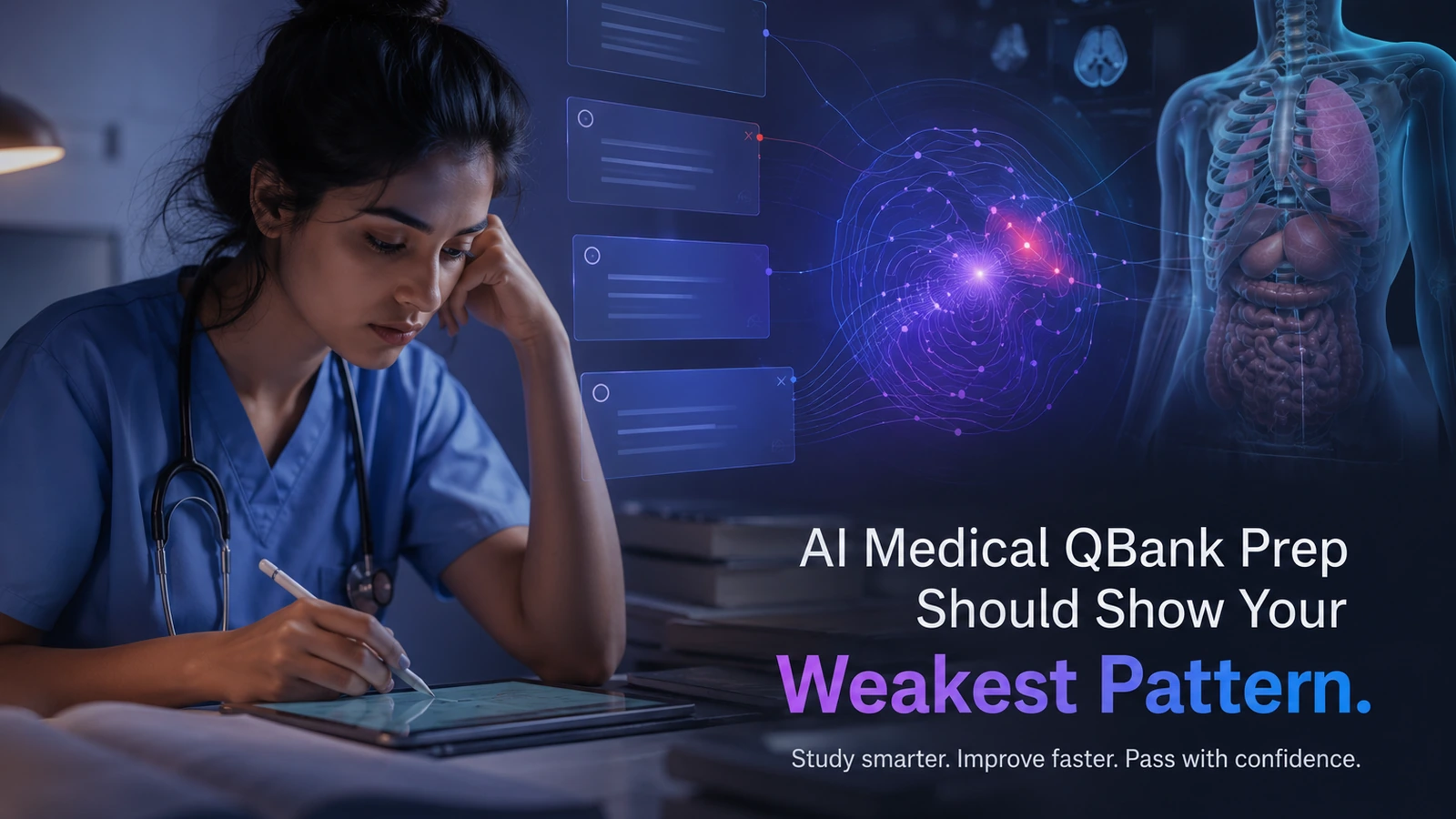
Exam candidates often do thousands of questions but still cannot explain why their score is stuck. The missing layer is not more volume; it is pattern visibility. That tension is why AI medical qbank weak areas is becoming a practical question, not a futuristic one.
An IMG preparing for a licensing exam keeps missing cardiology questions. The issue is not cardiology as a whole. It is interpreting murmur clues under time pressure, but the student only sees a flat percentage score. The reader does not need another abstract promise about digital transformation. They need a way to decide what belongs in the workflow, what should be measured, and where the technology stops helping.

Why this question matters now
Current policy and research signals point in the same direction: AI and digital learning are moving into medical education, but institutions are being asked to prove governance, training value, and workflow fit before they scale. AAMC is developing AI competencies across the medical education continuum, AMA's 2026 AI work highlights physician training needs and cautious optimism, and WHO guidance keeps returning to the same operational barriers: time, training, workload, infrastructure, ethics, and legal clarity.
For exam prep candidates, international medical graduates, medical students, the useful question is not whether AI or immersive anatomy will matter. It is how to use it in a way that improves learning or explanation without creating a new burden.
The reader tension behind the tool
An IMG preparing for a licensing exam keeps missing cardiology questions. The issue is not cardiology as a whole. It is interpreting murmur clues under time pressure, but the student only sees a flat percentage score. This is where many digital learning projects fail quietly. The demo is strong, but the moment of use is messy: a lecture is already full, a clinic visit is short, a student is tired, or an institution needs a rollout plan before anyone can evaluate outcomes.
The best answer starts with constraint. What does the learner, educator, clinician, or buyer need to do in the next ten minutes? What must they remember tomorrow? What would make them trust the tool enough to use it again?
For a related MeduTechs perspective, see For a broader study-loop comparison, see MeduTechs’ article on AI medical qbanks versus chatbot study habits.. That article is relevant because it expands the same reader problem from a nearby workflow rather than repeating the same product claim.
What Quiz Maker (MAIQ) is and where the feature helps
MeduTechs Quiz Maker (MAIQ) is an AI-powered medical exam-prep app for question practice, tutoring, remediation, and readiness workflows. In this article, the primary feature is Weakness Analytics: it analyzes quiz history to identify specific weak spots, such as a low-performing domain or repeated mistake pattern, so study time can move toward the highest-risk gaps.
That feature matters here because the reader's real problem is not simply access to technology. It is control at the exact point where understanding can either become clearer or become another layer of noise. MeduTechs should enter the workflow only after that problem is visible, and here the feature gives the reader a specific action they can imagine using.
Teams in this audience can also explore students exploring MeduTechs exam-prep workflows when they want a broader MeduTechs context for their role.

A practical workflow to use it well
The workflow should be simple enough that a busy reader can test it without a committee meeting.
1. Complete a short mixed session before choosing a topic.
This step keeps the article grounded in the reader's actual setting. It also protects the tool from becoming a shiny detour: the purpose is to improve the next learning, teaching, clinical explanation, or buying decision.
2. Review the lowest-performing domain and the repeated reasoning trap.
This step keeps the article grounded in the reader's actual setting. It also protects the tool from becoming a shiny detour: the purpose is to improve the next learning, teaching, clinical explanation, or buying decision.
3. Run a focused drill on that exact pattern.
This step keeps the article grounded in the reader's actual setting. It also protects the tool from becoming a shiny detour: the purpose is to improve the next learning, teaching, clinical explanation, or buying decision.
4. Use explanations to name why wrong options were tempting.
This step keeps the article grounded in the reader's actual setting. It also protects the tool from becoming a shiny detour: the purpose is to improve the next learning, teaching, clinical explanation, or buying decision.
5. Retest with timed questions only after the reasoning improves.
This step keeps the article grounded in the reader's actual setting. It also protects the tool from becoming a shiny detour: the purpose is to improve the next learning, teaching, clinical explanation, or buying decision.
The common mistake to avoid
The hidden risk is using an AI qbank as an endless question generator. Without weakness analytics, more questions can simply rehearse the same blind spot. This matters because medical education and clinical communication are high-trust environments. A feature can be useful and still be misused if the surrounding workflow is vague.
A safer habit is to ask one question before adding any AI, VR, AR, or analytics layer: what decision, memory, explanation, or action should be easier after the session? If the answer is not clear, the technology is probably being asked to carry too much of the teaching design.
A memorable way to think about it
A qbank becomes adaptive only when it changes the student’s next hour, not just the dashboard after the session. That is the line worth keeping. It turns the feature from a product detail into a workflow principle.
For MeduTechs, the point is not to replace the educator, clinician, or learner. The point is to make the anatomy, exam pattern, or deployment step visible enough that the human decision becomes better. That is a quieter promise, but in medical education it is the stronger one.

How to evaluate whether it worked
Use a small evidence loop instead of a vague success story. Did the learner explain the structure without the model? Did the patient understand the next step? Did the faculty member spend less time correcting the same misconception? Did the administrator know who was onboarded and where support was needed?
Those questions are modest, but they are the ones that decide whether a tool survives beyond the first week of excitement. They also keep claims honest: the article can recommend a workflow without pretending one feature solves every education or clinical communication problem.
If this workflow matches your current need, explore maiq through medutechs at https://maiq.medutechs.net/.
The bottom line
AI Medical QBank Prep Should Show Your Weakest Pattern is not only a technology story. It is a workflow story. The strongest use of Weakness Analytics happens when the reader has a specific bottleneck, a specific audience, and a specific moment where clarity matters.
MeduTechs becomes relevant when it helps that moment feel more controlled, more understandable, and easier to repeat. That is what separates a useful medical education product from another impressive demo.