
How Simulation Centers Can Tie VR Anatomy to Precision Education
Simulation centers rarely suffer from a lack of interesting technology. They suffer from a lack of repeatable fit. A VR anatomy experience can impress faculty, learners, and visiting leadership in a single afternoon and still fail to become part of the center's real training rhythm.
That is why the right question for Week 2 is not whether VR anatomy works in principle. Week 1 already covered how teaching hospitals can add VR anatomy without building a new lab. The more strategic question now is how a simulation center turns that capability into a governed, repeatable precision-education workflow rather than another impressive special event.
Current signals make this conversation more practical than it used to be. Meta's education offering is now broadly available, anatomy-specific VR evidence keeps improving, and 2026 medical-education signals are increasingly using precision-education language to describe how learning systems should adapt to different trainees.
Why demo success is a weak implementation signal
Simulation leaders know this pattern well. A new modality lands well in a showcase session, enthusiasm rises, and everyone agrees it has potential. Then the operational questions appear. Which learners need it most? Which session does it belong to? Which faculty own it? How often should it be used? What exactly is it improving?
If those answers stay fuzzy, the modality becomes episodic. It keeps winning attention and losing continuity.
VR anatomy is especially vulnerable to this because it can look complete on first exposure. Learners often remember the immersion more vividly than the instructional logic behind it. That is wonderful for engagement and dangerous for scale if the center never defines where the immersive step earns its place.
In other words, memorable is not the same as integrated. Simulation leaders already know that every strong modality needs a clear instructional job. VR anatomy becomes expensive theater when that job stays vague, and high-value infrastructure when the job becomes repeatable.
Precision education is a better scaling frame than immersion alone
Precision education helps because it forces the center to stop speaking in technology terms and start speaking in learner terms. Which trainee is this for? What weakness is it addressing? What timing makes the most sense? What feedback loop closes after the experience?
That is a stronger frame than “our center uses VR.” It turns the conversation toward selective value instead of broad enthusiasm.
The same logic shows up in current AMA precision-education work. The point is not to use advanced tools everywhere. It is to get the right intervention to the right learner at the right stage. Simulation programs can use the same lens when deciding how VR anatomy belongs in their pathways.
That lens is useful because it protects centers from overexpansion. Instead of asking how to give everyone more VR, the better question becomes which learners or scenarios gain the most from an immersive anatomy step and which do not. Selectivity is often what makes adoption durable.
A strong partner will therefore sound less like a headset reseller and more like a training designer. They will know where the immersive anatomy moment belongs, how faculty will debrief it, and what transfer signal would justify repeating it. That kind of operational clarity is what strategic buyers remember after the demo energy fades.
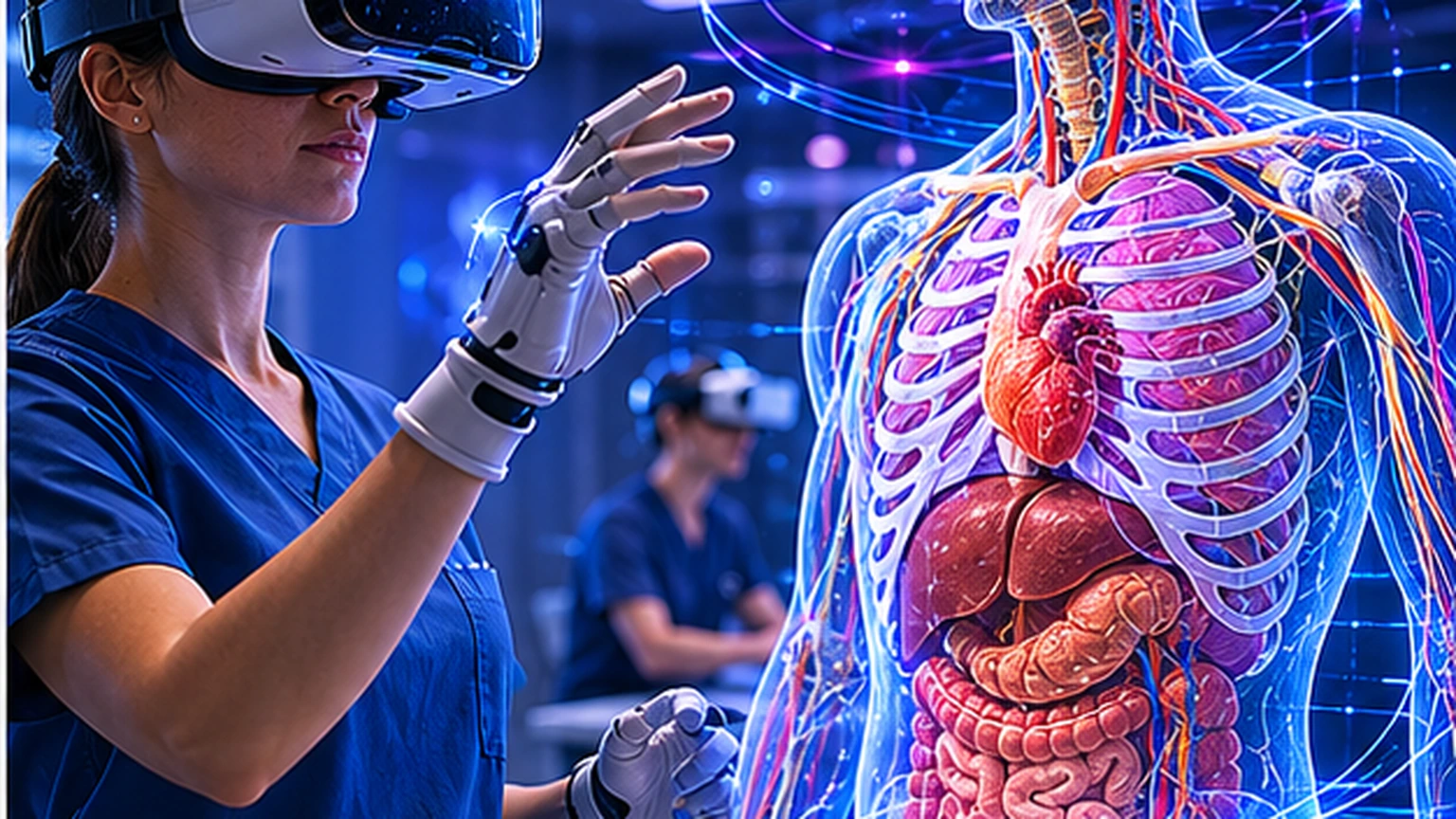
A practical integration model for simulation centers
1. Attach VR anatomy to a known failure point
Do not implement it because “spatial understanding matters.” Name the exact pain: procedure orientation, pre-brief anatomy refresh, difficult-region review, or confidence collapse before a scenario.
2. Define who the experience is for
Novices, rotating learners, residents, and cross-disciplinary teams often need different anatomy depth. Precision comes from narrowing, not widening, the intended user.
3. Decide what happens after the headset comes off
This is where many programs lose value. The immersive segment should feed directly into a debrief, repeat scenario, skills step, or remediation pathway. Otherwise the learning stays vivid but unanchored.
4. Build faculty ownership early
Programs scale better when the immersive anatomy layer belongs to faculty logic, not only to technical staff or innovation teams.
5. Track repeatability, not applause
The best early metrics are reuse, fit, and transfer into adjacent training steps. Audience excitement is nice. Repeat behavior is better.
This is where partner conversations get more honest. If learners love the experience but faculty do not reuse it, the problem is not enthusiasm. It is workflow fit. If leadership loves the showcase but debrief logic never changes, the center still does not have a real training layer.
That is why repeatability should be treated almost like a clinical sign. It tells you whether the modality has entered the bloodstream of the program or is still sitting on top of it. Strategic partners who understand that difference can help centers make smaller, smarter expansion choices instead of scaling confusion.
The common mistake: treating anatomy immersion as a separate island
When VR anatomy is treated as a special add-on, it often drifts away from the rest of the learning system. The center ends up with a beautiful optional experience that nobody quite knows how to place.
That is one reason standards matter. Simulation best-practice guidance and accreditation maturity both point toward intentional design, debrief logic, and structured educational integration. The immersive piece should not float outside that discipline.
It is also why the recent head-and-neck VR signal is useful. The value is not that “VR is cool.” The value is that targeted anatomy use can improve knowledge and confidence when the experience is focused and educationally intentional.
That should be reassuring for centers that worry they need a huge immersive strategy from day one. They do not. They need a targeted use that becomes dependable enough to repeat and specific enough to evaluate.
Where MeduTechs fits for strategic partners
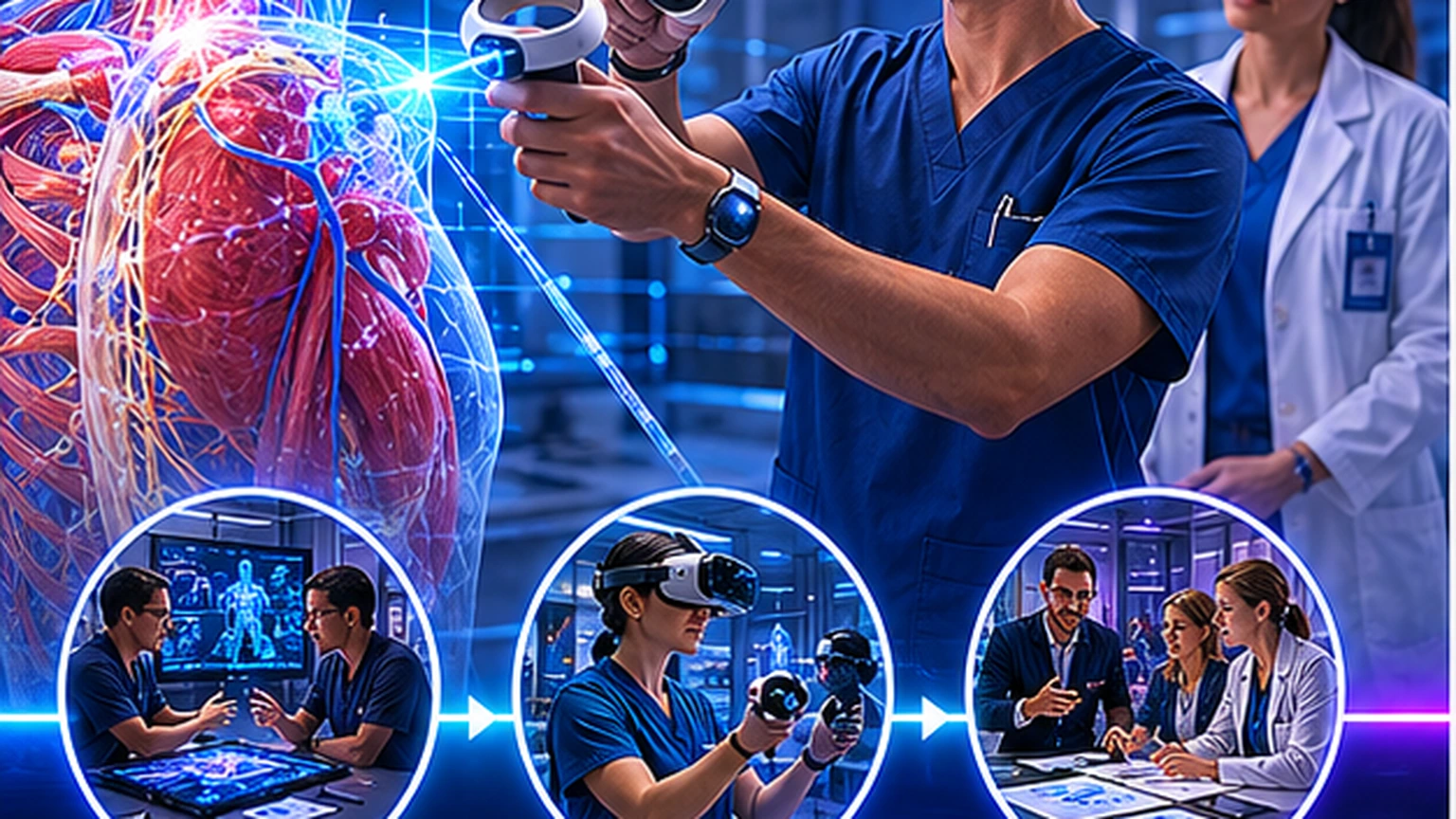
This is the point where MeduTechs can help without becoming a generic platform claim. If a center wants immersive anatomy to function like a governed training layer, then the VR App matters because it can sit inside a defined simulation workflow rather than outside it. The goal is not to produce wonder once. It is to support anatomy orientation in ways that faculty can repeat, adapt, and link to the rest of the training pathway.
That is easier to understand when paired with our Week 1 teaching-hospital VR article and the professor-controlled guide. Together they make the same argument from two sides: technology becomes strategic only when it becomes governable.
For broader related reading, the MeduTechs professors audience page is the closest contextual hub because faculty ownership is what usually makes or breaks long-term simulation adoption.
That faculty point is worth underscoring. When immersive anatomy belongs to the instructional team rather than only to the innovation team, it becomes much easier to refine, defend, and reuse. That is often the dividing line between a memorable pilot and a true partner-ready workflow.
It also improves collaboration with hospitals and teaching sites. Once faculty can explain exactly what the immersive step is doing, external partners can place it more confidently inside orientations, refreshers, or scenario prep rather than treating it as a standalone attraction. That makes the partnership itself easier to sustain.
A week 2 partner checklist
Before you approve another VR anatomy expansion, ask:
- Which learner problem is this attached to? 2. What training step follows the immersive segment? 3. Who owns instructional fit? 4. What repeat signal will justify scale? 5. What would tell us the experience is still only a demo?
That checklist sounds simple because the real work is simple to describe and hard to skip. Precision education is useful here because it turns immersive anatomy from a showcase into a system choice.
And that is the real strategic opportunity for Week 2. Not more immersion for its own sake, but more clarity about where immersion earns a durable place in the training pathway.
Centers that get that clarity early usually discover they need less spectacle and more design discipline. That is a much better long-term position to build from.
And for strategic partners, that is the clearest opportunity of all. The center does not need to be sold on immersion as a concept. It needs help turning immersion into a repeatable educational decision. That is where durable partner value starts.
Once that decision logic is in place, VR anatomy stops competing for attention and starts earning a place in the pathway. That is the difference between interesting technology and strategic infrastructure.
For simulation centers, that shift is what makes immersive anatomy scalable instead of seasonal. That is the long-term implementation win worth pursuing.
It is also the kind of win that makes future partner conversations easier, because the center can point to a workflow instead of only a demo memory.
Once that happens, immersive anatomy becomes easier to budget for, easier to schedule, and easier to defend as part of the center's actual educational strategy.
That is the kind of maturity strategic partners should be helping centers reach. It is what turns interest into infrastructure. And repetition into strategy. That shift matters. Quite a lot. Long term. For centers.
And faculty. As well. Together there.

Sources and further reading
- American Medical Association. Precision education. January 13, 2026. - EurekAlert. Virtual reality shown to improve medical students' understanding of head and neck anatomy. March 23, 2026. - PubMed. Efficacy of virtual reality and augmented reality in anatomy education: A systematic review and meta-analysis. 2024. - Society for Simulation in Healthcare. SSH-Accredited Programs Represent Nearly Half of Becker's Hospital Review's 2026 Simulation and Education List. April 22, 2026. - INACSL. Healthcare Simulation Standards of Best Practice. - AHRQ PSNet. Simulation Training. - Meta Newsroom. New Meta for Education Offering is Now Generally Available. February 2025.
Continue reading
Frequently asked questions
References
- Precision educationTrust A
- Virtual reality shown to improve medical students' understanding of head and neck anatomyTrust B
- Efficacy of virtual reality and augmented reality in anatomy education: A systematic review and meta-analysisTrust A
- SSH-Accredited Programs Represent Nearly Half of Becker's Hospital Review's 2026 Simulation and Education ListTrust A
- Healthcare Simulation Standards of Best PracticeTrust A
- Simulation TrainingTrust A
- New Meta for Education Offering is Now Generally AvailableTrust A