
What Professor-Controlled AI Anatomy Teaching Should Look Like
Anatomy faculty do not need more reminders that AI is arriving. What they need is a way to use it without giving away the teaching judgment that makes a course coherent. The anxiety is reasonable: if students can ask a tool for everything, the course can quickly slide from structured learning into shortcut consumption.
That does not mean faculty should reject AI or 3D anatomy tools outright. It means the tool has to remain inside a professor-controlled teaching model. Recent anatomy AI reviews support exactly that kind of caution. AI can help, but the educational value depends on boundaries, grounding, and the way the tool sits inside actual teaching practice.
The real faculty problem is not adoption. It is control.
Most professor conversations about AI anatomy tools sound like technology conversations, but the real issue is pedagogical control.
You are not just asking whether a tool can explain the brachial plexus. You are asking whether:
- it follows your terminology - it supports the sequence you teach - it helps correct misconceptions rather than hide them - it strengthens retrieval instead of replacing it
If the answer is no, the tool may still impress students while quietly weakening the course.
Why shortcut learning is the hidden risk
Students love smooth explanations. That is exactly why faculty should be careful. A polished answer can create the feeling of understanding long before durable understanding exists.
In anatomy, that risk is amplified. Spatial relationships, layered structures, and regional transitions are easy to nod along with and hard to retrieve independently. Research on retrieval practice in anatomical education makes the practical point clearly: students retain more when they must bring knowledge back out, not just recognize it when it is presented beautifully.
So the faculty question becomes sharper: how do we use AI and 3D support without destroying the retrieval burden that actually builds competence?
The answer is not “never use the tool.” The answer is “design the tool's role.”
That role should be visible to students, not hidden in faculty intention. If learners do not know when they are supposed to recall alone, when they are allowed to ask for clarification, and when the 3D layer is only for orientation, the tool will quietly flatten the course into on-demand explanation.
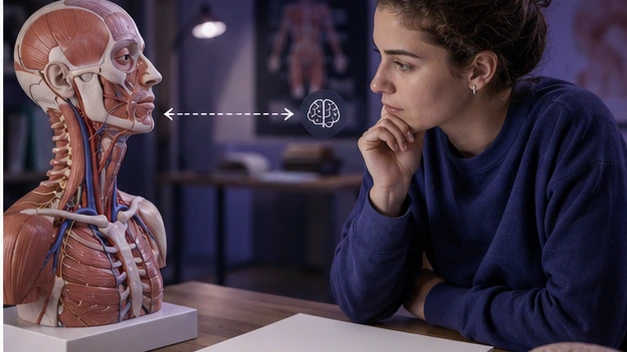
A faculty-first framework for using AI in anatomy
I would frame professor-controlled AI anatomy teaching in four moves.
1. Preview with boundaries
Students can use the tool before lecture or lab to orient themselves to structures, regions, and vocabulary. The rule is that preview should reduce confusion, not replace the core teaching event.
2. Teach with visible control
During lecture or lab, the professor should remain the authority on sequence and emphasis. If a 3D or AI layer is used, it should follow the instructor's teaching path, not distract into side conversations.
3. Retrieve without rescue
After explanation, students should still have to label, isolate, describe, or compare structures from memory. If the tool always rescues them instantly, it becomes a fluency machine instead of a learning tool.
4. Review with misconception correction
The best post-session use is not passive rereading. It is targeted review around known weak points, especially where students confuse adjacency, innervation, blood supply, or layered relationships.
What this looks like in a real classroom workflow
Imagine a thorax session. Before class, students use a controlled 3D view to orient themselves to mediastinal relationships. During class, the professor decides which regions and transitions matter, using one shared anatomy path rather than letting every student branch into random prompts. After class, students complete a retrieval task: label the boundaries, identify one structure hidden beneath another, and explain one clinical implication without live AI help. Only then do they return to the tool for feedback.
That workflow keeps the professor in charge of order and emphasis. It also keeps the student's own reasoning load intact.
The common mistake: using AI to answer before students think
The most common faculty mistake is letting the tool speak too early.
If students see the explanation before they have tried to retrieve, compare, or orient the structure themselves, the AI becomes a shortcut to recognition. They may feel more confident, but the confidence is poorly calibrated.
This is where professor control matters more than generic AI enthusiasm. The tool should arrive at the point where it clarifies or checks, not at the point where it replaces effort.
One practical classroom tactic is to make the retrieval burden public. Ask students to commit to a label, a branch order, or a spatial description before the corrected view appears. That preserves productive struggle without turning the technology into the villain.
Where a controlled anatomy layer helps
This is where MeduTechs can support a faculty workflow naturally. The strongest use is not “ask the AI anything.” It is a professor-led anatomy environment where the explanations, labels, and learning path can stay anchored to the instructor's course logic.
That is why the Professor Web Portal is the right feature to highlight here. Its value is not novelty. Its value is alignment. If a professor needs anatomy descriptions to match lecture language before class, that control changes the product from a generic companion into a course-shaped teaching tool.
The same logic is reflected in the MeduTechs professor audience page, which fits the faculty reader better than a broad product pitch. It points to a teaching model, not just a software list.
After the misconception and retrieval framework is clear, the contextual CTA is simple: if your course is considering anatomy AI, define the moments where students must think without rescue before you decide how the tool appears.
For some courses that will mean post-lab review. For others it may be the ten minutes before lecture starts, or a structured remediation loop after a low-stakes quiz. The specific location matters because students behave differently in each part of the course.
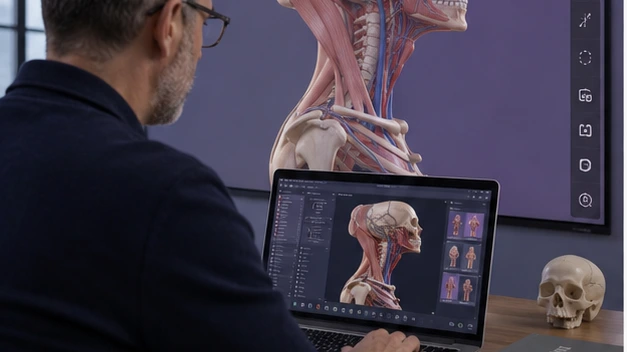
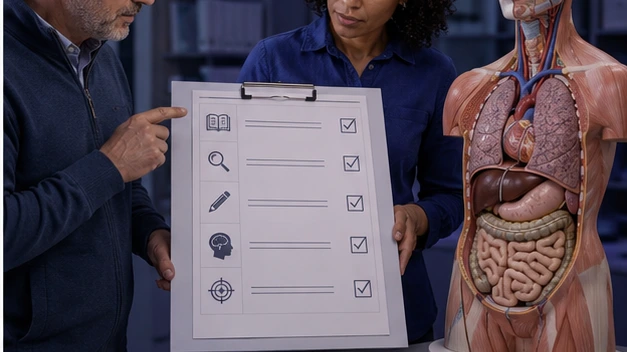
A checklist for anatomy educators before adopting any AI layer
- Decide which parts of the course the tool may support - Protect retrieval moments where students work without instant answers - Align terminology to the lecture and lab sequence - Name the misconceptions you want the tool to help surface - Choose one measure of success beyond student enthusiasm - Review where the product might accidentally over-explain too early
It also helps to decide where the tool should stay out of the way. If a practical exam is approaching, for example, students may need more unaided recall time and less explanatory comfort. A good faculty policy says so directly.
Why this matters now
The 2026 conversation is shifting from “should we try AI?” to “how do we govern it without losing educational quality?” That is a better conversation for faculty, because it assumes professors are still the designers of learning.
The best anatomy tools will support that role. They will not ask faculty to surrender it.
That is the standard worth protecting. A useful product should make your teaching more transferable and more consistent, not less central.
Students usually notice that difference quickly. A controlled AI layer still feels like part of the course. An uncontrolled one feels like the course has been replaced by browsing.
That is a useful litmus test for faculty. If the course identity starts to disappear, the AI role has already become too large.
In other words, the tool should reinforce your pedagogy, not dissolve it.
If it cannot do that, it is not really helping you teach anatomy. It is only changing the medium of confusion.
Faculty deserve a stronger outcome than that. They deserve tools that preserve rigor while reducing repetitive explanation load.
That is the version of AI anatomy teaching that faculty can defend to themselves and to students.
It preserves trust where it matters. That is the point.
Sources and further reading
- PubMed, “Artificial intelligence in anatomy education: a systematic review of ChatGPT's effectiveness as a learning tool” (2026) - PubMed, “Artificial Intelligence in Anatomic Education: Educational Utility, Safety Boundaries, and Implementation Considerations” (2026) - PubMed, “Retrieval Practice for Improving Long-Term Retention in Anatomical Education” (2021) - PubMed, “Efficacy of virtual reality and augmented reality in anatomy education” (2024) - University of Nebraska Medical Center, “UNMC holds inaugural conference on AI in health” (2026)
Continue reading
Frequently asked questions
References
- Artificial intelligence in anatomy education: a systematic review of ChatGPT's effectiveness as a learning toolTrust A
- Artificial Intelligence in Anatomic Education: Educational Utility, Safety Boundaries, and Implementation ConsiderationsTrust A
- Retrieval Practice for Improving Long-Term Retention in Anatomical EducationTrust A
- Efficacy of virtual reality and augmented reality in anatomy education: A systematic review and meta-analysisTrust A
- UNMC holds inaugural conference on AI in healthTrust A