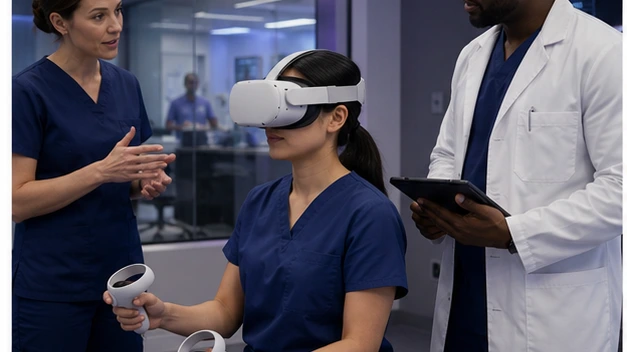
How Teaching Hospitals Can Add VR Anatomy Without Building a New Lab
Teaching hospitals and simulation centers do not need more innovation theater. They need tools that improve repeatability, learner readiness, and faculty workflow without forcing a costly reset of space, staffing, and curriculum design.
That is why VR anatomy is worth revisiting now. Not because every center needs a futuristic rebuild, but because many programs already have anatomy-dependent training moments where learners would benefit from a repeatable immersive refresher before the higher-stakes simulation begins.
The mistake is assuming the first step must be big.
For strategic partners, that is actually encouraging. It means a center can test value without redesigning space, rewriting the whole curriculum, or making the faculty learn an entirely new operating model in one jump.
The best first question is not “what headset?”
It is: where is the repeatable training friction? That friction might show up as:
- residents arriving to simulation with weak anatomy orientation - faculty spending too much time re-explaining foundational structure before the main scenario - inconsistent prebrief depth across learners - limited opportunities for deliberate, risk-free anatomy review between sessions
If the center cannot name that friction clearly, the VR project will probably drift into novelty.
That one question is also what keeps partner conversations grounded. A center that can say, “we lose fifteen minutes every session re-orienting learners to this anatomy relationship,” is much closer to a workable pilot than a center that only says, “we should do something with VR.”
It also creates a clean before-and-after comparison. If the friction is specific, the partner can later ask whether the VR layer actually reduced it, not just whether people liked using a headset.
That kind of specificity is what makes a partner pilot credible in budget conversations. Leaders can fund a defined improvement more easily than a broad promise of innovation.
Why the standards conversation matters
Simulation leaders already operate in a standards-conscious environment. SSH accreditation and INACSL standards keep reinforcing that strong programs are not built on technology alone. They depend on facilitation quality, professional integrity, learner assessment, and repeatable design.
That is exactly why a focused VR anatomy layer can be useful. It can strengthen the prebrief or refresher portion of the workflow without pretending to replace the full simulation program.
In other words, the value may show up before the main simulation even starts. Better orientation can make the main scenario more consistent, the debrief more focused, and the faculty effort more efficient.
That is a much stronger partnership story than “immersive learning is the future.” It ties the technology to a measurable operational benefit inside the current program.
It also respects the fact that many hospital education teams are already overloaded. A partner tool should remove friction from an existing workflow, not create a second workflow that staff now have to defend.
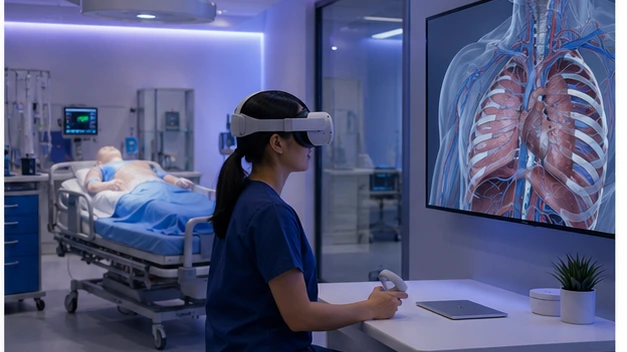
A practical pilot model for hospitals and centers
1. Choose one training moment
Pick one anatomy-heavy scenario that repeatedly costs time or confidence.
2. Define the role of VR narrowly
Is it a prebrief orientation, a resident refresher, or a between-session remediation tool? The answer should be one of those, not everything at once.
3. Keep faculty ownership visible
The simulation faculty or education lead should still control objectives, sequence, and debrief logic. VR should support the flow, not hijack it.
4. Measure repeatability
Did the pilot reduce setup explanation time? Did learners arrive better oriented? Did faculty report more consistent readiness? Those are stronger early signals than delight alone.
They are also easier to discuss with operations leaders than vague statements about immersion. Repeatability is the language partners can actually use when deciding whether to scale.
It is also worth tracking whether faculty feel the tool reduced explanatory repetition. In many centers, instructor energy is an invisible cost. If VR anatomy takes some of the repetitive orientation load off the faculty team, that matters operationally even before a formal outcome study exists.
Hospitals often underestimate this because faculty time is spread across simulation prep, clinical supervision, assessment, and debrief. A pilot that protects even a small portion of that time can be more valuable than its hardware cost suggests.
The common mistake: overbuilding before proving workflow fit
Many centers make the same error with emerging tools: they over-commit before they identify the smallest useful win.
That can look like buying too many devices, designing around a future-state dream, or adding content that is disconnected from the center's existing simulation priorities. The result is often a technically impressive asset that faculty do not use consistently.
A smaller pilot is not less ambitious. It is more honest.
It also produces cleaner debrief. When the VR component has one clear role, faculty can ask whether it helped that role. When the role is vague, nobody knows whether the pilot succeeded.
The overbuild risk is especially high in partner settings because space and hardware decisions can look strategic long before the educational use case is proven. A measured pilot protects the center from that trap.
It also preserves optionality. If the first scenario works, the center can expand intelligently. If it fails, the team can pivot without being trapped by a giant infrastructure narrative.
Where MeduTechs becomes practical for partners
This is where MeduTechs can support a strategic partner model naturally. The right primary feature here is the VR environment itself, because the partner need is immersive anatomy context that can plug into an existing workflow.
The most credible story is not “replace your simulation center.” It is “add a repeatable anatomy layer where your learners currently arrive under-prepared.”
That is also why the contextual CTA should be operational: if your hospital or center is exploring immersive learning, identify the single anatomy-heavy scenario where better prebrief orientation would save the most faculty time.
For some centers that will be airway anatomy before emergency scenarios. For others it might be orthopedic orientation before a procedure block or a resident refresher before a multidisciplinary exercise. Scenario choice shapes the quality of the evidence you can collect.
That is where MeduTechs can be useful as a partner-facing anatomy layer rather than a standalone spectacle. The immersive environment matters because it keeps the refresher embodied and memorable, but the business case still comes from workflow fit.
For teams comparing adjacent deployment angles, the MeduTechs clinic audience page is the closest exact public context link because it shows how anatomy explanation workflows already map into real care environments.
That is an important distinction for strategic partners. The immersive quality helps the learner, but the repeatable process is what convinces the institution.
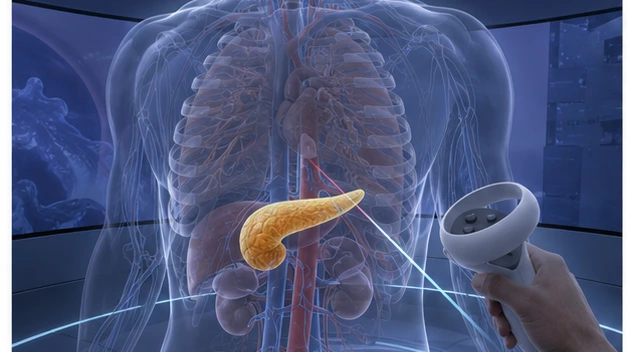
A good partner checklist before scaling
- Name the exact simulation workflow pain point - Define whether VR is prebrief, refresher, or remediation - Keep facilitation and debrief ownership with faculty - Limit the pilot to one repeatable scenario family - Review whether the tool improved readiness, not just excitement - Expand only after the use case proves itself
If you cannot explain why the first scenario earned expansion, the center is probably moving too fast. A strategic partner rollout needs a growth logic, not just enthusiasm.
The checklist also helps with internal alignment. Operations leaders, educators, and clinical champions can disagree about technology while still agreeing on whether one clearly defined scenario improved.
That shared definition of improvement is what gives a pilot the chance to become a program instead of remaining a side project.
Without it, even a promising tool can disappear after the first burst of enthusiasm. With it, a center has a real basis for expansion.
That matters because hospitals rarely scale tools on immersion alone. They scale them when the operational story is disciplined enough to survive leadership review, educator skepticism, and the everyday pressure of running training programs.
That is the kind of proof a real strategic partner can use. It is concrete, fundable, and repeatable. Those are the traits leadership can actually back. And the traits a long-term partner needs. That is why measured pilots win.
They survive scrutiny. And scale. Cleanly. Repeatably. Safely. Together.
Why now is the right moment for a measured rollout
The current environment is more favorable than it was a few years ago. Recent VR anatomy evidence is stronger, simulation standards are clearer, and centers are more comfortable evaluating educational technology through operations instead of novelty alone.
That means a disciplined pilot can now generate meaningful proof faster than before, as long as the center stays focused on repeatability and instructional fit.
That is the real opportunity in 2026. Partners can learn quickly without pretending they need to rebuild the whole training stack on day one.
For teaching hospitals and simulation centers, that is the most practical form of innovation: targeted, standards-aware, and repeatable enough to scale only after the first use case proves itself.
It is also the kind of innovation partners can explain upward to hospital leadership. The ask is not “fund a VR dream.” It is “help us solve one recurring training problem in a controlled way.”
That framing travels well because it sounds like operations, education quality, and patient-safety discipline all at once. In hospital settings, that is usually the language that earns the next conversation.
Sources and further reading
- SSH, “SSH-Accredited Programs Represent Nearly Half of Becker's Hospital Review's 2026 Simulation and Education List” (2026) - INACSL, “Healthcare Simulation Standards of Best Practice” - AHRQ PSNet, “Simulation Training” (2023) - PubMed, “Efficacy of virtual reality and augmented reality in anatomy education” (2024) - EurekAlert, “Virtual reality shown to improve medical students' understanding of head and neck anatomy” (2026)
Continue reading
Frequently asked questions
References
- SSH-Accredited Programs Represent Nearly Half of Becker's Hospital Review's 2026 Simulation and Education ListTrust A
- Healthcare Simulation Standards of Best PracticeTrust A
- Simulation TrainingTrust A
- Efficacy of virtual reality and augmented reality in anatomy education: A systematic review and meta-analysisTrust A
- Virtual reality shown to improve medical students' understanding of head and neck anatomyTrust B