
How to Recover After AI Explains Too Much in Anatomy Study Week
There is a very specific kind of bad study week that feels good while it is happening. You sit with an AI tool, ask smart questions, get clean explanations, and leave each session feeling calmer than when you started. Then two days later you try to recall the brachial plexus, the layers of the abdominal wall, or the branches of a nerve pathway without help and the answer is not really there.
That crash is frustrating because it makes you feel as if the study time disappeared. It did not disappear. It just built familiarity faster than retrieval. In anatomy, that gap shows up brutally because the subject punishes fuzzy recall and weak spatial reconstruction.
If our Week 1 student article showed how to use AI without outsourcing your thinking, this Week 2 piece is for the moment after you already went too far. How do you recover when the AI explained too much and your memory did not keep up?
Why these study weeks feel so productive
AI explanations reduce friction. That is part of their appeal. They answer quickly, adapt to your wording, and make confusing topics feel less intimidating.
The problem is that understanding after the fact is not the same as recall before the fact. Retrieval-practice research keeps pointing to the same distinction: pulling the answer out is its own learning event. If the AI keeps supplying the answer before you have tried to reconstruct it, you never get that event often enough.
A related problem is confidence drift. A recent study linking search-supported diagnostic work and self-confidence is useful here because it shows how easily confidence can rise in an easy-answer environment. Your brain starts mistaking recognition for mastery.
That is why these weeks can fool disciplined students as easily as struggling ones. You are not being lazy. You are reacting to a study format that rewards feeling informed. Once you see that clearly, the recovery becomes much less emotional and much more mechanical.
The signs that AI explained too much
You do not need a perfect self-audit. Look for four clues.
You can follow but not initiate
If an explanation makes sense while you read it, but you cannot start the answer alone later, the session was too explanation-heavy.
You know the label, not the relationship
Students often remember isolated names after an AI session yet lose the anatomical relationship that makes the name useful.
Your notes look cleaner than your recall
This is a painful one. Nicely organized notes can hide weak memory.
You feel better than your quiz performance suggests
If your confidence rose but your recall test did not, trust the test.

The week 2 recovery loop
The fix is not to panic and ban every AI tool. The fix is to move AI later in the study loop.
1. Start with a blank-sheet recall pass
Pick one region or pathway and write or say everything you can remember before opening anything. This is the fastest way to expose what is actually missing.
2. Sort the misses into types
Was the problem label recall, sequence, spatial orientation, or relationship confusion? You recover faster when the weakness is named precisely.
3. Use AI only for narrow repair
Now ask for one repair at a time. Do not request a full review of the whole topic if the real issue was, for example, the order of branches or the relation between structures.
4. Return to the structure
After the repair, go back to the anatomy view, model, or region. You need to reconnect the explanation to the spatial object.
5. Re-test under variation
Change the prompt or angle. Can you answer from a different landmark, image orientation, or clinical framing?
That last step matters because familiarity often collapses when the view changes.
Students who skip that variation step often believe they fixed the weakness because the original explanation feels smoother on reread. In reality, they only improved recognition. The changed-angle test is what separates repaired understanding from repeated comfort.
The common mistake: using AI to feel caught up
When you are behind, it is tempting to let AI condense everything. That can be emotionally relieving, but it usually deepens the exact weakness that causes exam stress later. The more overloaded you feel, the more you need diagnostic study, not comfort study.
This is where the QBank-versus-chatbot study loop article is helpful. It explains why explanation-first sessions can create false confidence. What matters now is that you use that insight as a correction tool, not as a reason to beat yourself up.
There is also a practical emotional benefit to this reset. Once you put recall back at the start of the loop, you stop having to guess whether you studied “well enough.” The gap becomes visible. That can bruise your confidence for a day, but it usually gives you far more control by the end of the week.
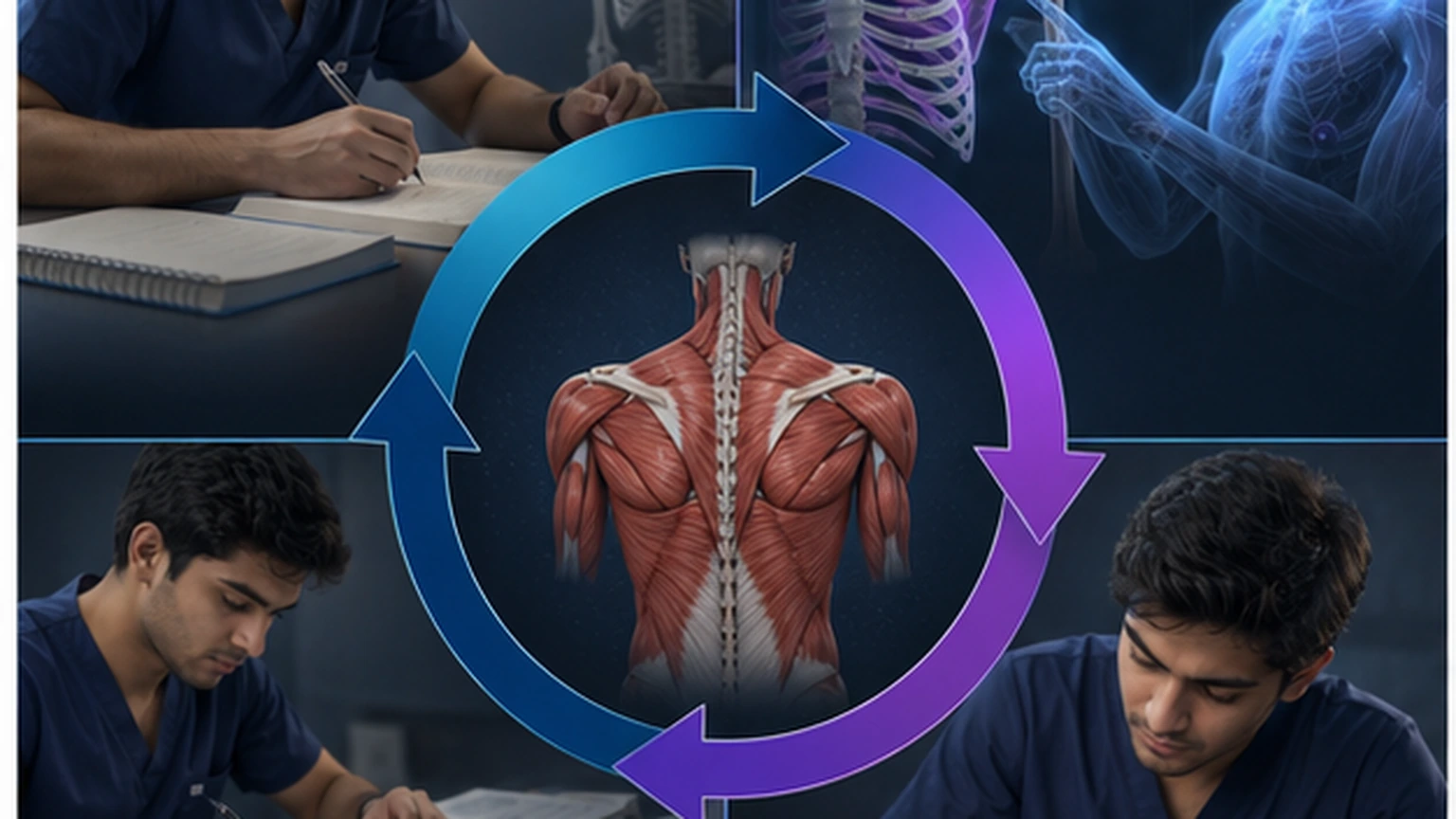
Where MeduTechs can support the reset
This is where MeduTechs fits naturally. When your study routine needs more structure, a visual anatomy environment helps because it keeps the repair step anchored to the body rather than to abstract text alone. The AI Tutor is most helpful when it works inside that bounded context, and features like 3D exploration or part isolation make it easier to reconnect explanation to structure.
That is also why the MeduTechs students audience page matters as contextual reading. It gives you adjacent study patterns without turning the article into a product pitch. The point is not to use more features. The point is to use the right support at the right stage of the loop.
That distinction is what makes the routine sustainable. You do not need a perfect new system. You need a loop where the anatomy stays visible, the weakness stays specific, and the AI does not get to grade its own usefulness.
A 30-minute reset block you can use tonight
Try this:
- 8 minutes blank recall. 2. 6 minutes miss sorting. 3. 8 minutes narrow AI repair. 4. 5 minutes anatomy re-orientation. 5. 3 minutes changed-angle self-test.
It is short on purpose. Recovery works better when it is sharp enough to repeat tomorrow.
If you repeat that block for three or four days on the same weak region, you usually learn something important: the problem was not that you needed more explanation volume. The problem was that you needed more honest contact with the material.
The memorable insight to keep
If the session made you feel smarter before it made you prove anything, it was probably upside down. Good AI use in anatomy is not explanation first. It is explanation after the weakness becomes visible.
That is the shift that brings your confidence back into contact with reality. And in anatomy, that is what real progress feels like.
It is less glamorous than a marathon AI session and much more trustworthy. In a heavy week, that trust is often the difference between drifting and recovering.
And once you recover that trust, the rest of the week usually becomes easier to manage. You are no longer studying to feel okay. You are studying to find out what is actually getting stronger.
That is a much better place to study from. It is also the place where retention usually starts improving again.

Sources and further reading
- PubMed. Comparing different retrieval practice strategies using virtual patients: A stratified randomized trial. January 2026. - PubMed. Retrieval Practice for Improving Long-Term Retention in Anatomical Education. 2021. - PubMed. Relationship between diagnostic accuracy and self-confidence among medical students when using Google search. 2025. - PubMed. Artificial intelligence in anatomy education: a systematic review of ChatGPT's effectiveness as a learning tool. January 13, 2026.
Continue reading
Frequently asked questions
References
- Comparing different retrieval practice strategies using virtual patients: A stratified randomized trialTrust A
- Retrieval Practice for Improving Long-Term Retention in Anatomical EducationTrust A
- Relationship between diagnostic accuracy and self-confidence among medical students when using Google searchTrust A
- Artificial intelligence in anatomy education: a systematic review of ChatGPT's effectiveness as a learning toolTrust A