
How to Study Anatomy With AI Without Outsourcing Your Thinking
If you are a medical student, you already know the temptation. You open a chatbot or study tool because one anatomy region is still not making sense, and within seconds you get a clean explanation. It feels efficient. Sometimes it is. But if you use that pattern too early or too often, anatomy study can start to feel better while your actual recall gets weaker.
That is the trap. AI can save time, but it can also flatten the struggle that helps you remember. Recent anatomy AI research and retrieval-practice studies both point in the same direction: the tool is most helpful when it supports your own effort, not when it replaces it.
So the goal is not to avoid AI. The goal is to use it in a way that keeps your brain doing the hard part.
Why anatomy is unusually vulnerable to shortcut learning
Anatomy is not just facts. It is spatial memory, layered relationships, orientation, and precision under pressure. That means recognition is especially dangerous. If you keep seeing the structure in a polished explanation before you try to reconstruct it yourself, you may feel prepared while actually building weak recall.
That is why students often say, “I understood it when I studied, but I could not bring it back in the exam.” The issue is not intelligence. The issue is the study loop.
This is also why long explanations can be deceptive. The more complete the answer looks on screen, the easier it is to confuse “I can follow this” with “I can produce this when nobody is helping.”
A better rule: retrieval first, AI second
The simplest fix is also the most useful. Try to retrieve before you ask. That can mean:
- naming the structures from memory - drawing the pathway roughly - describing the relation in your own words - identifying what sits superficial or deep
Only after that should the AI layer enter. When it does, use it to compare your answer with a clearer explanation, not to generate the first answer for you.
If you want a simple rule, make the tool answer your second question, not your first one. Your first question belongs to your own memory.

A four-step anatomy routine that works with AI instead of around it
1. Prime the region
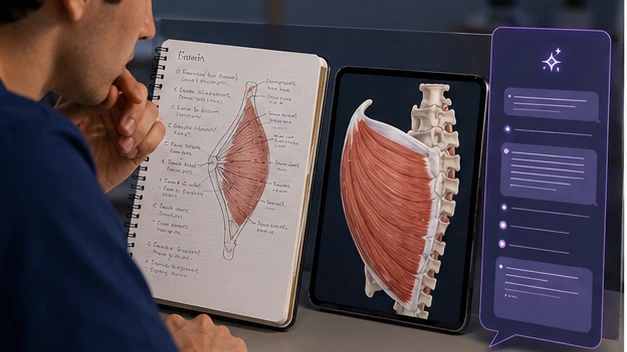
Use a 3D or visual tool to orient yourself to the body region before deep memorization. This is where 3D anatomy can save time by making the territory clearer.
2. Close the help and retrieve
Name the structures, trace the path, or sketch the relationship without live support. This is the step students skip most often.
3. Use AI as a check, not a crutch
Now ask the anatomy AI one narrow question: what did I miss, what relation is incorrect, or how should I think about this structure clinically?
4. Finish with one harder self-test
Do one more recall task after the AI explanation. That second retrieval is the moment that turns correction into retention.
The common mistake: turning every weak spot into instant explanation
Students often use AI at the exact moment when discomfort would have produced learning. The structure feels fuzzy, so the tool explains it immediately. The discomfort disappears, but the retrieval work never happens.
A recent study on self-confidence and search-supported diagnosis is a helpful warning sign here. Easy access to answers can change confidence faster than competence. The principle maps well to anatomy revision: a smoother study session is not always a stronger one.
That is why students who rely heavily on explanation-first study often feel unusually good at the end of the night and unusually bad in the next unaided quiz. The sensation of mastery arrived sooner than the memory.
Where 3D anatomy helps most
Not every problem in anatomy needs AI. Some problems need a better visual anchor. 3D anatomy is especially helpful when:
- a region is hard to rotate mentally - you keep losing track of depth - structures cross more than one plane - labels make sense individually but not relationally
That is why a good study workflow does not treat 3D tools and AI as the same thing. The 3D layer helps you see. The AI layer helps you check and clarify. Your memory work still has to come from you.
One useful sign that the 3D layer is working is that your notes become more relational. You stop writing isolated labels and start describing what lies above, beneath, behind, or through another structure.
What this workflow looks like with MeduTechs
This is where MeduTechs fits naturally for students. The most useful entry point is not endless conversation. It is anatomy-specific guidance inside a visual environment that keeps the question tied to what you are actually studying.
If you are reviewing a region, isolating one structure, and then asking a targeted anatomy question after your own attempt, the AI becomes a tutor-like check instead of a shortcut machine. That is the right context for a tool like MeduTechs' anatomy AI.
The MeduTechs student audience page makes sense here because it speaks to the learner workflow rather than pretending one generic AI habit works for everyone.
The practical CTA is small but important: if you want faster revision, change the order of your study loop before you change apps. Retrieve first. Ask later.
That advice matters even more when you are stressed and behind. Time pressure makes explanation-first study feel irresistible, but that is usually when you most need a harder and more honest signal.
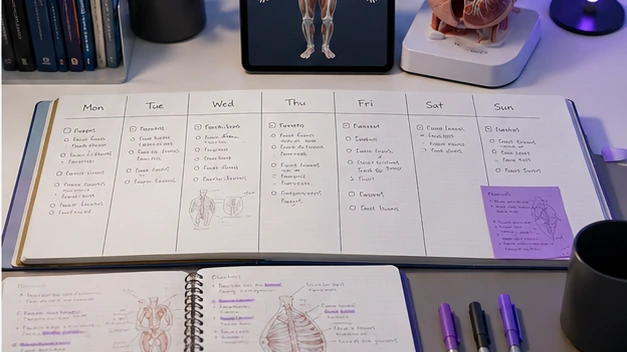
A weekly anatomy study rhythm for busy students
If your schedule is crowded, keep the rhythm simple.
On first contact, use the 3D view to orient the region. On second contact, retrieve from memory. On third contact, use AI to correct one narrow gap. On fourth contact, test yourself again without help.
That loop is much less glamorous than “ask AI anything,” but it is far more likely to protect recall.
If you have a viva, OSCE, or oral anatomy check coming up, add one more layer: say the explanation out loud after you review it. Spoken retrieval exposes weak spots quickly and makes the AI check more valuable afterwards.
The memorable insight
The biggest mistake is not using AI. It is using AI before your memory has had a chance to struggle productively.
Once you see that, your whole routine changes. The tool stops being the brain and starts being the mirror.
That is the habit worth keeping, because it still works when the app changes, the course gets harder, or the next tool promises even faster answers.
And it makes later review more efficient, because every explanation has already passed through your own memory once before you trust it.
That is how the tool stays useful without quietly becoming the thing that does the learning for you.
It protects speed without sacrificing ownership. That tradeoff is exactly what most students need from AI. Speed helps only when memory still stays in charge. Otherwise the pace is just deception. Better to feel slower and remember more.
That is real progress. Not just better feelings. Better recall too. That is what lasts. Long term. Always.
Sources and further reading
- PubMed, “Artificial intelligence in anatomy education: a systematic review of ChatGPT's effectiveness as a learning tool” (2026) - PubMed, “Retrieval Practice for Improving Long-Term Retention in Anatomical Education” (2021) - PubMed, “Comparing different retrieval practice strategies using virtual patients” (2026) - PubMed, “Relationship between diagnostic accuracy and self-confidence among medical students when using Google search” (2025) - PubMed, “Efficacy of virtual reality and augmented reality in anatomy education” (2024)
Continue reading
Frequently asked questions
References
- Artificial intelligence in anatomy education: a systematic review of ChatGPT's effectiveness as a learning toolTrust A
- Retrieval Practice for Improving Long-Term Retention in Anatomical EducationTrust A
- Comparing different retrieval practice strategies using virtual patients: A stratified randomized trialTrust A
- Relationship between diagnostic accuracy and self-confidence among medical students when using Google searchTrust A
- Efficacy of virtual reality and augmented reality in anatomy education: A systematic review and meta-analysisTrust A