
Why Generic Chatbots Create Exam False Confidence and What a Better Weakness Loop Looks Like
The most dangerous exam-prep feeling is not panic. It is calm built on the wrong signal.
Generic chatbots are very good at creating that signal. They explain quickly, answer politely, and make weak understanding feel more organized than it really is. For medical exam prep, that is a problem because performance does not come from having seen an explanation. It comes from surviving repeated uncertainty under pressure and then repairing the exact weakness that showed up.
That is why the real comparison in 2026 is not "AI versus no AI." It is "generic answer generation versus a disciplined weakness loop."
Why false confidence happens so easily
Generic AI is optimized to keep the interaction moving. That is useful in many contexts, but in exam prep it creates a subtle trap. The more fluent the explanation feels, the easier it is to confuse comprehension with readiness.
Students often come away thinking:
- I understand the concept now - I could probably answer this on test day - I have covered this topic enough for today
But none of those beliefs has been tested. They are mood signals, not performance signals.
That distinction matters because medical exam performance depends on three things generic chat often weakens:
- response under timing pressure 2. discrimination between close distractors 3. honest tracking of recurring weak zones
What exam prep actually needs
Good exam prep is less about broad explanation and more about targeted correction. You need to know:
- what kind of question you keep missing - why you miss it - whether the mistake is conceptual, careless, or pattern-based - what the next drill should be
A generic chatbot usually cannot hold that loop well on its own. It may explain the answer, but it does not naturally force the cycle of pressure, error detection, and remediation that high-stakes preparation requires.

The weakness loop students actually need
Here is the better sequence.
Step 1: answer under pressure
You need questions that feel like performance, not browsing.
Step 2: diagnose the miss
Did you misunderstand the stem, confuse two similar structures, miss a mechanism, or fall for a distractor pattern?
Step 3: remediate the exact gap
This is where AI can help if it stays narrow and corrective rather than expansive.
Step 4: return to a fresh version
If you do not see the concept again in a new form, the weakness is still hiding.
Step 5: track the pattern over time
One wrong answer is an event. Repeated wrong answers in the same category are a system.
That is the heart of the weakness loop. It turns performance into guidance.
Why generic chatbots break this loop
They break it in three predictable ways.
They overexplain instead of prioritizing
The student gets more text than needed and less decision support.
They smooth over distractor logic
Many exams are won by understanding why close wrong answers are attractive. Generic chat often gives the correct answer without making the trap memorable.
They do not naturally keep score on recurring weakness
The student leaves each session with information but not a map.
That is why strong exam systems feel narrower than general-purpose AI. Their value comes from disciplined repetition around weakness, not from unlimited explanation.
Where MAIQ becomes the practical next step
This is where a purpose-built exam workflow matters.
The most relevant MeduTechs feature for this lane is Daily Weakness Task in MAIQ. Its practical value is that it can turn yesterday's miss into today's starting point instead of forcing the learner to rebuild that plan manually. Supporting features like Weakness Analytics and an infinite AI Q-bank help because they keep the correction loop active rather than one-off.
If you want more student-side study and exam-prep context around this kind of routine, MeduTechs' student-focused anatomy articles are the natural internal next read.
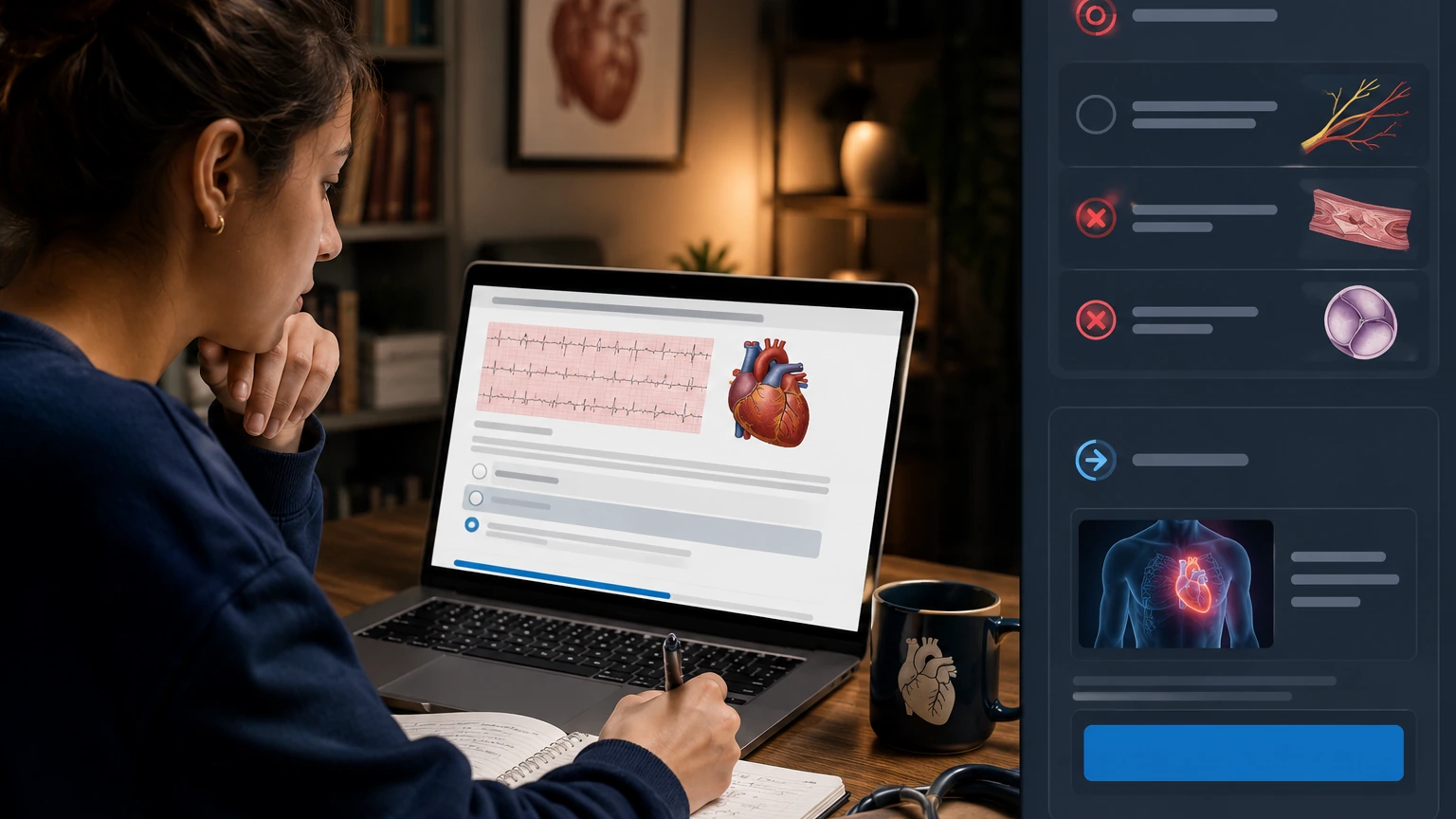
A practical daily routine for IMGs and medical students
Use this for a 60- to 90-minute session.
Block 1: timed set
Start with a short timed question set. Do not warm up with explanation content first.
Block 2: weakness sort
Tag every miss as concept, distractor, recall, or time-pressure error.
Block 3: narrow remediation
Use AI or review only for the specific tagged weaknesses.
Block 4: fresh variation
Answer new questions that target the same weak zone in a different form.
Block 5: next-day assignment
Write down the one weakness you must face again tomorrow. This is the discipline generic chat does not naturally impose.
The hidden risk most candidates ignore
The hidden risk is studying in a way that protects your mood more than your score. Broad chatbot review feels safe because it reduces uncertainty quickly. But if uncertainty disappears before performance is tested, the weak spots remain intact.
That is why the better question after every session is not "Did I learn something?" It is "Did I expose a weakness clearly enough that tomorrow's session can attack it?"
One memorable rule for exam week
If the tool never makes your weak areas impossible to ignore, it is helping you feel ready more than it is helping you become ready.
That is the difference between generic AI comfort and an actual exam-prep system.
One useful extension is a seven-day weakness board. Instead of tracking dozens of topics, track the five patterns that actually keep returning: renal physiology stems, brachial plexus branches, acid-base interpretation, distractor-heavy cardiology items, or imaging orientation errors. Each day, attack one pattern with a timed question set, a short remediation pass, and a fresh variation. At the end of the week, keep only the patterns that still survive correction. That board gives your prep a shape, and shape is what broad chatbot study often lacks.
It also gives you a cleaner handoff between weeks. Instead of starting every Monday by asking what to study, you start with the patterns your own performance already exposed.
That makes your preparation less emotional and more diagnostic, which is exactly what most candidates need as the exam gets closer.
It also reduces the temptation to chase random reassurance when what you really need is another deliberate correction cycle.
That is how confidence becomes earned instead of borrowed.
And that is usually the exact shift that separates candidates who are reviewing from candidates who are improving.
The better the weakness loop gets, the less you need motivation tricks and the more you can trust the pattern in your own data.
That trust is what lets you keep preparing even when the score line is still uneven.
And that is usually what lifts the final month of prep above guesswork. That is the whole point of a real weakness loop.
A concrete distractor example
Suppose you miss a physiology item not because you forgot the core concept, but because two distractors looked almost right under time pressure. A generic chatbot may simply restate the correct explanation. A better exam workflow asks why the distractor appealed to you, what cue you overlooked in the stem, and what variant question would expose the same weakness tomorrow.
Why this matters especially for IMGs
International medical graduates often have an extra layer of risk: they may know the medicine but still need to recalibrate to a question style, distractor logic, or timing pattern that differs from what they used before. That makes weakness tracking even more important than broad content explanation.
That is also why daily repetition matters more than marathon review. A candidate who confronts one weakness loop every day usually builds more honest readiness than one who spends a weekend absorbing elegant explanations and hoping they stick.
For many IMGs, that daily loop is also what rebuilds confidence because it turns exam prep into a sequence of solvable corrections rather than a vague question about whether they are "ready enough."

Sources and further reading
- ChatGPT as a Learning Tool for Medical Students: Results From a Randomized Controlled Trial - Artificial Intelligence in Medical Education: a Scoping Review of the Evidence for Efficacy and Future Directions - Medical students' attitudes toward AI in education: perception, effectiveness, and its credibility
Continue reading
Frequently asked questions
References
- ChatGPT as a Learning Tool for Medical Students: Results From a Randomized Controlled TrialTrust A
- Artificial Intelligence in Medical Education: a Scoping Review of the Evidence for Efficacy and Future DirectionsTrust A
- Medical students' attitudes toward AI in education: perception, effectiveness, and its credibilityTrust A