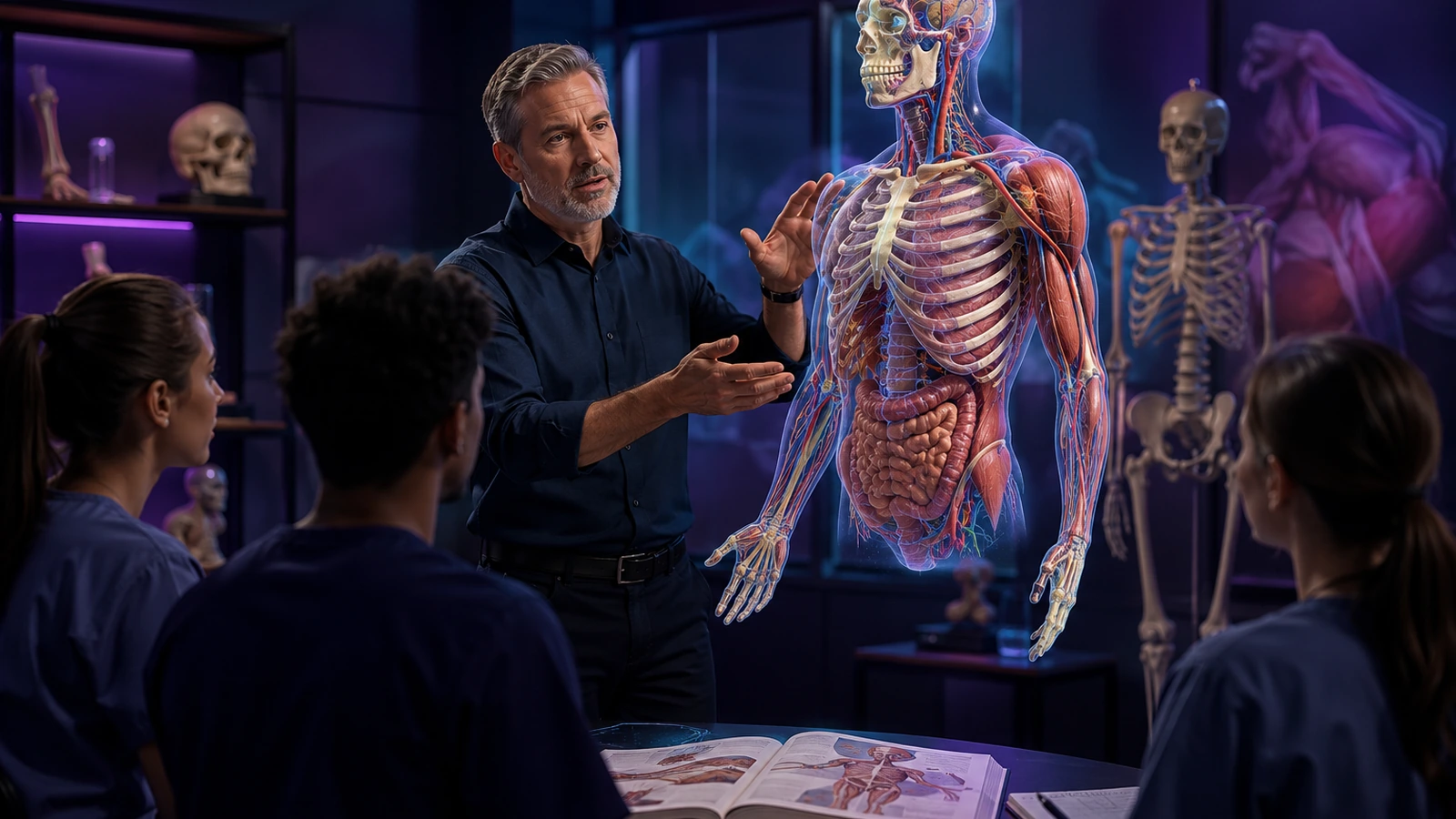
Anatomy educators are under pressure from two directions at once. Students expect more flexible digital support, and AI tools are now everywhere. At the same time, professors know exactly how easily a smooth answer can hide shallow understanding. That tension is why many faculty members do not need a sales pitch for AI. They need a teaching model they can actually trust.
The strongest current policy and research signals back up that instinct. The EU Council’s May 11, 2026 statement on AI in education puts teacher agency at the center of adoption. Reviews of generative AI in medical education also keep returning to the same caution: AI is promising, but the educational design still matters. In anatomy, that matters even more because spatial understanding can be faked by recognition long before it is mastered by retrieval.
The direct answer is that professor-controlled anatomy AI should guide attention, prompt retrieval, and align with course language. It should not become an always-on answer engine that quietly teaches students to stop thinking.
Why anatomy professors are right to be cautious
Professors are right to be cautious because anatomy is unusually vulnerable to false confidence. Students can look at a labeled structure, feel familiar with it, and still fail to explain relations, layers, or clinical meaning on their own. When AI is added badly, that gap can widen. Students get quicker explanations but weaker ownership of the knowledge.
That is why a serious teaching tool needs to support how a professor teaches, not just what the student asks. The platform has to respect terminology choices, lecture sequence, and the difference between introducing a concept and testing whether it can be recalled. If a tool cannot fit that rhythm, it often ends up living outside the course rather than strengthening it.
The faculty opportunity is to use AI and immersive anatomy to create better question pathways, clearer visual transitions, and tighter alignment between lecture, lab, and revision. That is a much stronger educational aim than "let students ask anything at any time."
A classroom scenario that shows the real problem
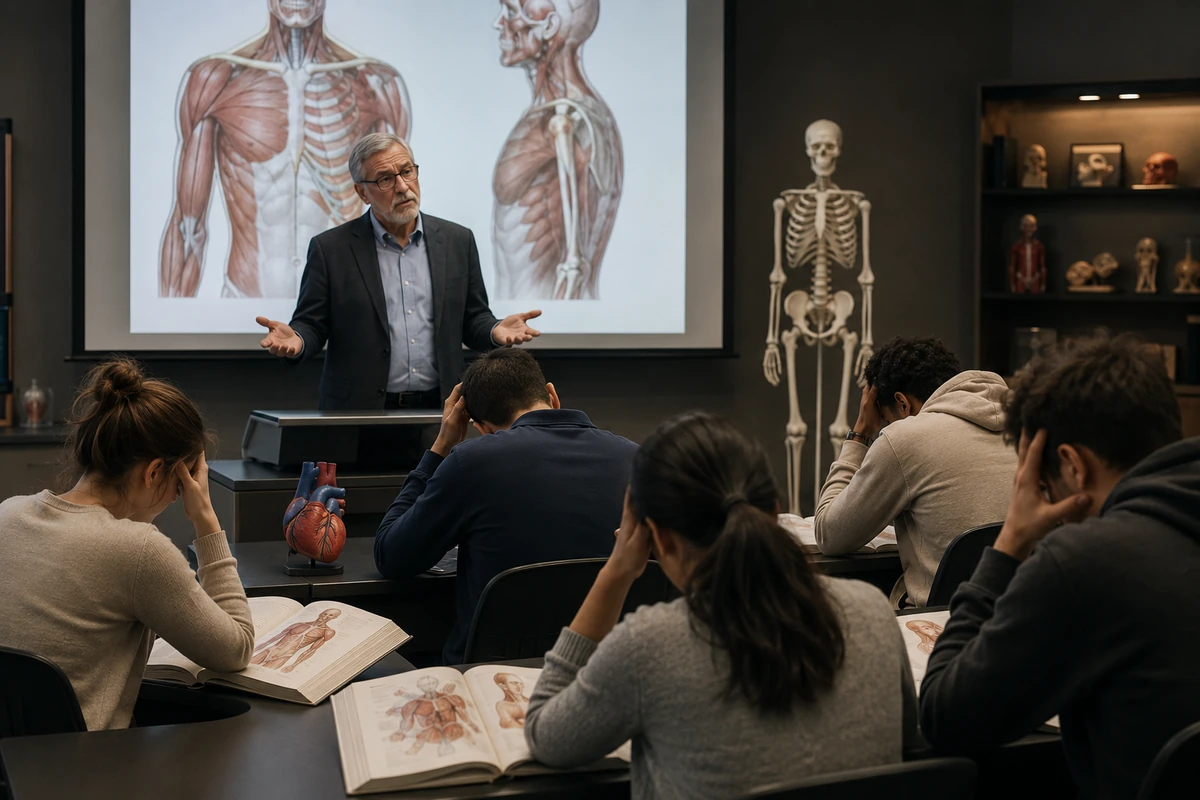
Picture a thorax lecture in week three of a gross anatomy block. Students can identify the mediastinum on a slide, but many still confuse layers, boundaries, and how structures relate once they move away from the exact image used in class. During office hours, the same questions appear repeatedly. In lab, students recognize structures they just saw but struggle to reconstruct the area from memory.
That scenario is common because the real bottleneck is not exposure. It is controlled repetition plus spatial reasoning. Professors are doing the same clarification work again and again while students continue to drift toward recognition-based study habits.
A useful tool in this scenario would not dump a textbook into a chatbot window. It would help the professor reinforce the same conceptual map across lecture, 3D exploration, and revision. That is a much more specific and valuable job.
From answer-giving to retrieval-guided teaching
The teaching goal should be retrieval-guided understanding, not answer delivery. In practice, that means students see a structure, then are asked to locate relationships, predict what is hidden underneath, or explain why a boundary matters before the system gives them the full explanation. That style of prompting is much closer to how durable anatomy knowledge is built.
The 2025 state-of-the-art review on retrieval practice in the health professions is helpful here because it reinforces what educators already know intuitively: repeated recall strengthens learning better than passive review. When an anatomy tool supports retrieval rather than bypassing it, it becomes pedagogically aligned instead of merely convenient.
That does not mean every session must feel like an exam. It means the platform should create productive friction. Students should move from seeing to naming, from naming to relating, and from relating to teaching the idea back. That is the kind of loop professors can defend academically.
A professor-control framework for AI and 3D anatomy
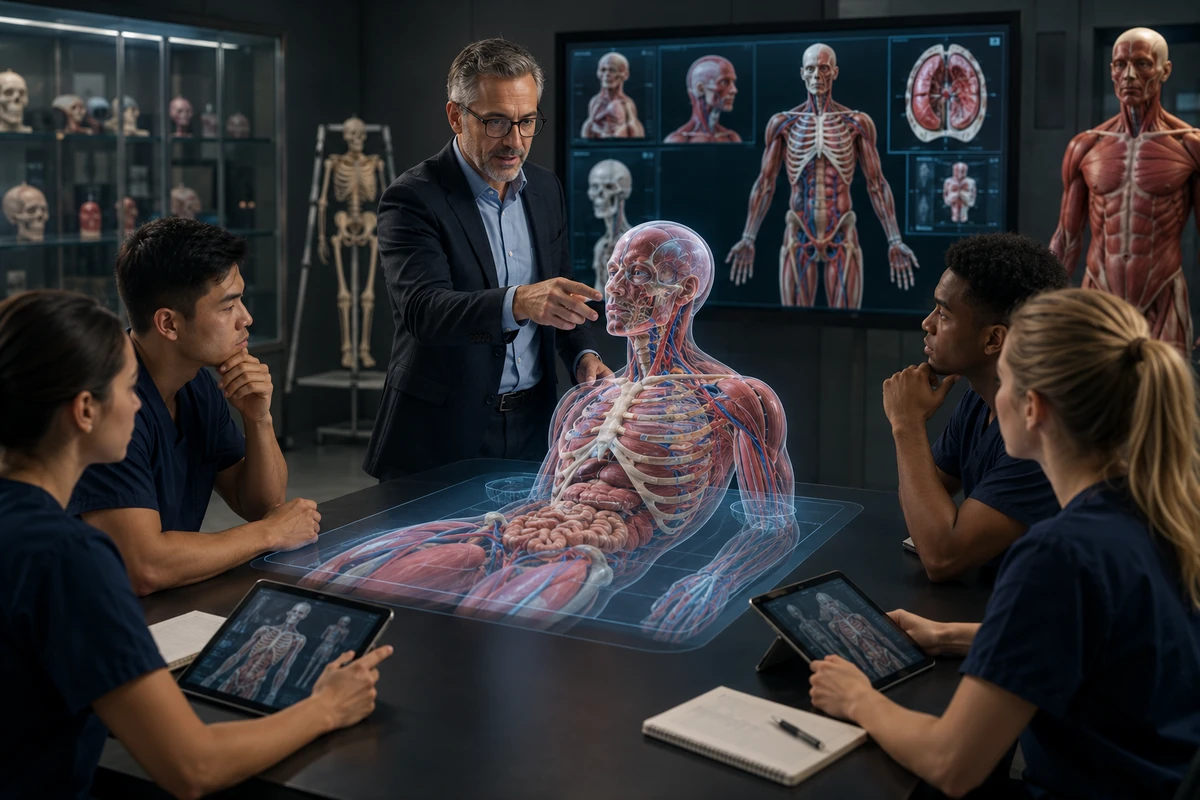
A practical professor-control framework has four parts. First, define the concept map you want students to carry out of the session. Second, decide where 3D or immersive visualization adds value beyond slides. Third, determine which AI prompts help students retrieve rather than copy answers. Fourth, align the language with how you actually teach the course.
This is where editable faculty control becomes essential. If the tool can surface professor-specific language or teaching emphasis, students stop experiencing lecture and digital study as separate worlds. That reduces confusion and gives faculty a reason to trust the platform as part of the course rather than as a parallel influence.
For more examples organized around this perspective, the professor anatomy education guides audience page is the right contextual follow-on link because it keeps the reader inside the same faculty problem space.
How MeduTechs can support the workflow without replacing the educator
MeduTechs fits naturally when the discussion stays anchored in faculty control. The Professor Web Portal is not valuable because it adds more features to a slide. It is valuable because it lets teaching teams shape how anatomy explanations appear and align the digital layer with the course itself.
That matters far more than generic personalization language. In a professor-led workflow, Lecture Sync and the Nomenclature Toggle support clarity only because the professor still owns the conceptual path. The technology becomes a reinforcement layer, not a substitute authority.
If that model matches your teaching priorities, explore MeduTechs after the framework is clear. The product connection should come after the teaching logic, not before it.
Common teaching mistakes with anatomy AI
The first teaching mistake is letting AI answer before the student has attempted retrieval. The second is treating immersive anatomy as a visual wow factor rather than a reasoning tool. The third is failing to align terminology, which creates subtle friction that students often experience as confusion rather than as a content gap.
Another mistake is measuring engagement without checking whether the interaction actually changed understanding. A busy tool can still teach poorly. Faculty should ask whether the platform improved the quality of explanation, questioning, and revision around a real course problem.
When educators avoid those traps, AI and 3D anatomy can strengthen pedagogy. When they do not, the same tools can make weak habits faster.
What to do in your next lecture block
For the next lecture block, choose one concept students routinely misunderstand. Map the retrieval steps you want them to take. Decide where a 3D transition adds real value. Then test whether the tool helps you reinforce that chain instead of shortcutting it.
That is a manageable starting point, and it reflects the human-centred direction the broader education sector is already moving toward. Professors remain the guide, the critic, and the designer of the learning experience. The software earns its place by making that work easier to scale.
In anatomy education, that is the standard worth keeping. AI should sharpen teaching judgment, not replace it.

See professor anatomy education guides for more context from the same audience lane.
If this faculty model feels right, see how MeduTechs supports professor-led anatomy teaching for the product view.
Professors also benefit when the tool makes the transition between lecture and self-study more coherent. Students often leave class with partial understanding, and the best digital support does not just repeat the lecture. It extends it in the same language, with the same intellectual priorities, so the student experiences one teaching system instead of two competing ones.
Sources and further reading
- AI in Education: Council Calls for Human-Centred Approach (2026-05-11; official) - Technologies, Opportunities, Challenges, and Future Directions for Integrating Generative Artificial Intelligence into Medical Education: A Narrative Review (2025-10-02; academic) - The Use of Retrieval Practice in the Health Professions: A State-of-the-Art Review (2025-07-17; academic) - Efficacy of Virtual Reality and Augmented Reality in Anatomy Education: A Systematic Review and Meta-analysis (2024-09-19; academic) - Ensuring AI Use in Education Leads to Opportunity (2026-03-05; official)
Continue reading
Frequently asked questions
References
- AI in Education: Council Calls for Human-Centred ApproachTrust A- European policymakers want AI in education to preserve teacher agency, safety, and inclusion.
- Technologies, Opportunities, Challenges, and Future Directions for Integrating Generative Artificial Intelligence into Medical Education: A Narrative ReviewTrust A- GenAI can support self-directed learning, simulation, and formative feedback when used with safeguards.
- The Use of Retrieval Practice in the Health Professions: A State-of-the-Art ReviewTrust A- Retrieval practice remains one of the strongest learning methods in health professions education.
- Efficacy of Virtual Reality and Augmented Reality in Anatomy Education: A Systematic Review and Meta-analysisTrust A- VR and AR can improve anatomy knowledge scores when used thoughtfully in education.
- Ensuring AI Use in Education Leads to OpportunityTrust A- Institutions are shifting from broad AI access to structured educational use with training and governance.