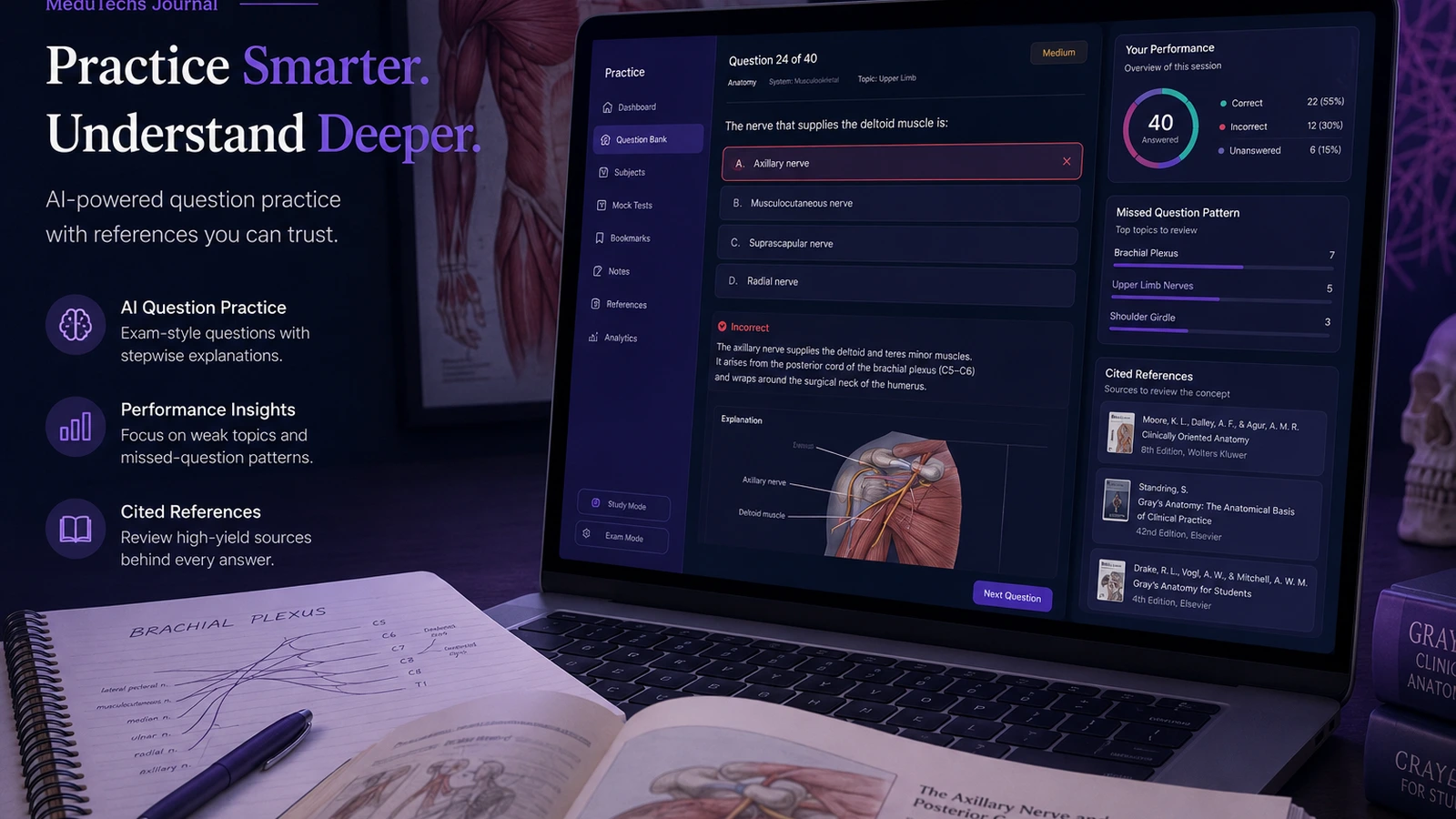
What AI Question Practice Should and Should Not Do for Medical Exam Prep
Students want more targeted practice, but AI-generated questions are risky unless the references, limits, and review workflow are visible. That is the practical problem behind this MeduTechs Journal article. The point is not to chase a shiny tool. The point is to ask what a credible anatomy learning workflow should protect: academic oversight, clear anatomy context, useful repetition, and honest limits.
Recent signals make the question timely. Anatomy educators are gathering around XR, virtual anatomy, imaging-linked teaching, and AI-supported lesson development, while higher education teams are also trying to make AI governance workable in real programs. Those signals do not prove that any one platform improves outcomes. They do show that medical education leaders are looking for tools that can be implemented carefully rather than added as another disconnected experiment.
Where MeduTechs Fits
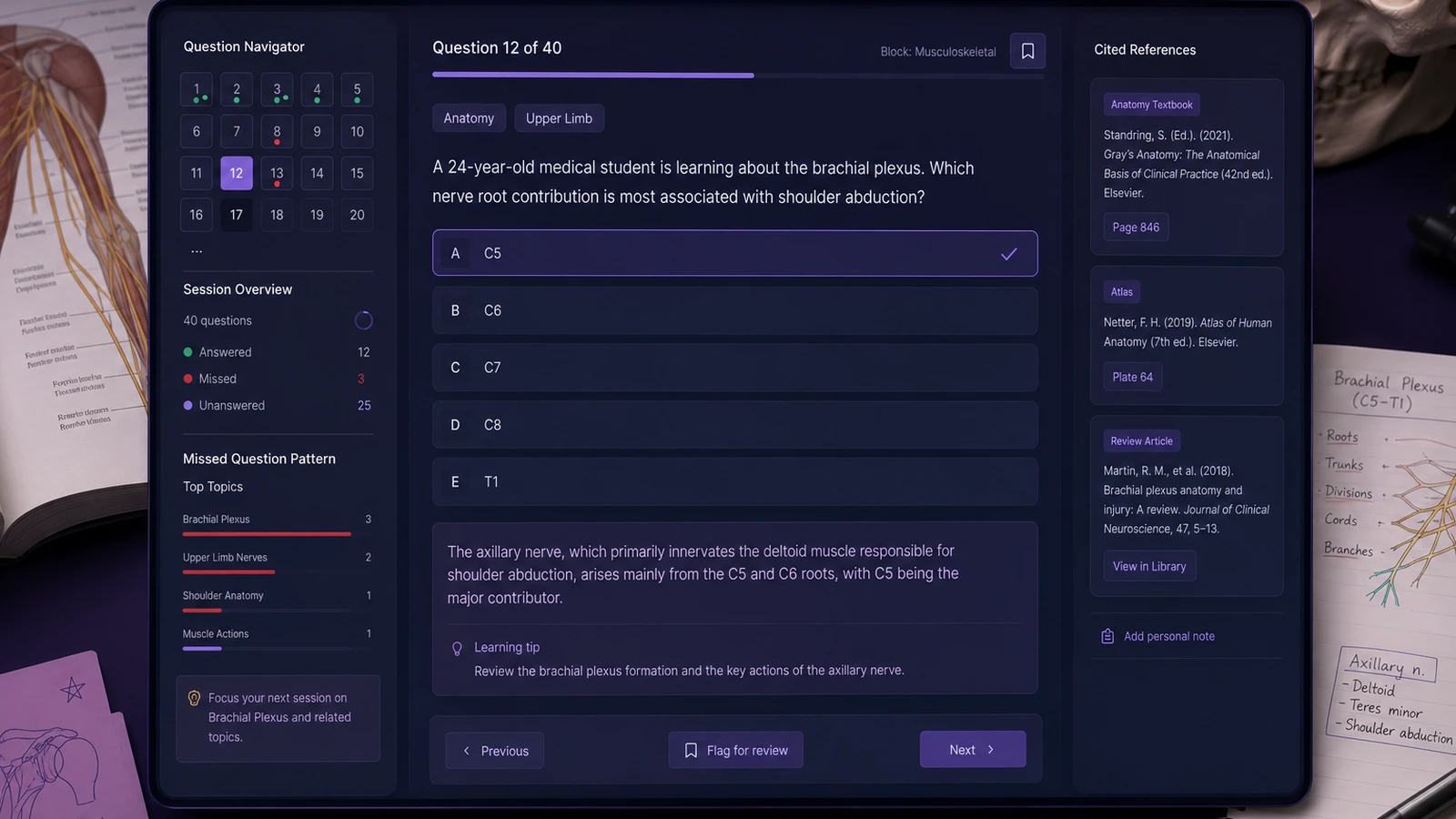
MeduTechs is a professor-validated AI and VR anatomy platform. In this article, the relevant app is MAIQ Quiz Maker and the relevant feature is Verified Academic References. Verified Academic References keep generated practice tied to cited academic material so students can review the source trail instead of trusting a question blindly. This matters for medical students preparing for exams because the feature addresses a real workflow problem before it asks anyone to care about the product.
The useful way to think about MeduTechs here is narrow and concrete. It is not a replacement for faculty judgment, clinical reasoning, cadaveric teaching, imaging practice, or supervised instruction. It is a structured anatomy learning layer that can make a specific part of the learning or explanation workflow easier to see, repeat, or govern.
What The Reader Should Look For
For medical students preparing for exams, the first test is whether a tool makes the existing job clearer. A good anatomy product should reduce friction around one identifiable task: finding a structure, narrowing a VR scene, reviewing a professor-approved explanation, managing a cohort, or checking the source trail behind a practice question. If the tool cannot name that job, the demo is probably doing more work than the product.
Verified Academic References should be explained in normal language: what it is, where it appears, who uses it, what problem it helps with, and what it does not claim to solve. That keeps the article specific to MeduTechs without turning it into sales copy.
The Evidence Boundary
The external sources used for this plan support the wider context: anatomy curricula are still grounded in established teaching while adding imaging and modern technology; educators are experimenting with XR and AI-supported learning; and VR anatomy research continues to develop. They do not validate MeduTechs as an externally studied intervention. Any article or package that claims otherwise should be blocked.
Verified Academic References should be explained in normal language: what it is, where it appears, who uses it, what problem it helps with, and what it does not claim to solve. That keeps the article specific to MeduTechs without turning it into sales copy.
A Practical Workflow
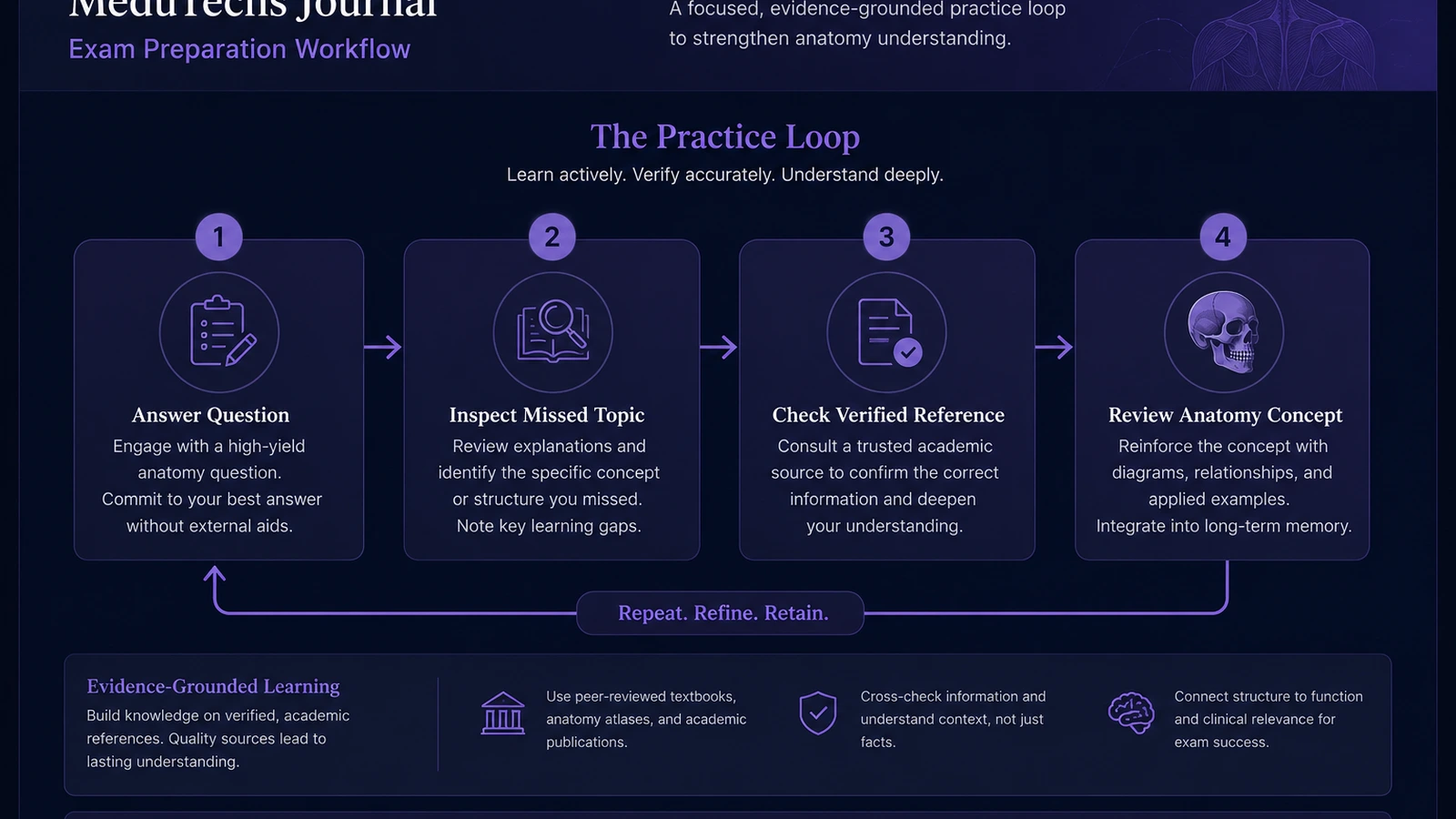
A practical workflow starts with the learner or educator's immediate pressure. In this lane, the pressure is: students want more targeted practice, but ai-generated questions are risky unless the references, limits, and review workflow are visible. The MeduTechs feature should enter only after that pressure is clear. Used well, Verified Academic References gives the reader a way to handle that pressure without overstating what the software can know or prove.
Verified Academic References should be explained in normal language: what it is, where it appears, who uses it, what problem it helps with, and what it does not claim to solve. That keeps the article specific to MeduTechs without turning it into sales copy.
How To Avoid The Wrong Claim
The safest language is specific. Say that the tool can help a learner see, organize, review, or explain anatomy. Do not say that it diagnoses, treats, improves scores, guarantees retention, replaces professors, or proves clinical competence. In medical education, honest limits are not weak positioning; they are part of trust.
Verified Academic References should be explained in normal language: what it is, where it appears, who uses it, what problem it helps with, and what it does not claim to solve. That keeps the article specific to MeduTechs without turning it into sales copy.
What A Good Next Step Looks Like
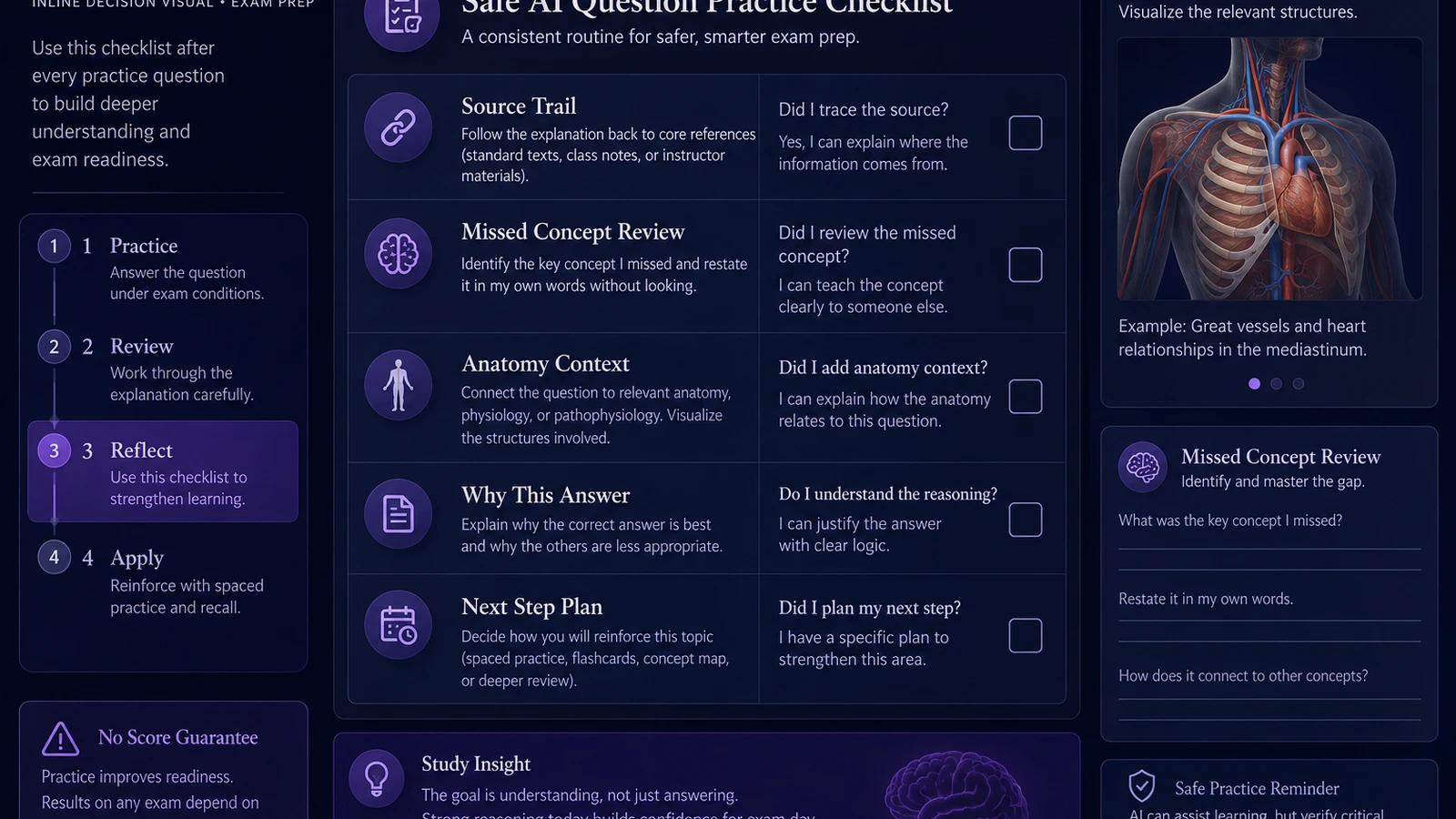
The next step is not a generic request for a demo. It is a focused question: can this app-feature combination support one real workflow for medical students preparing for exams without adding unsupported claims or cross-lane confusion? For this lane, that means evaluating MAIQ Quiz Maker and Verified Academic References against a real teaching, study, explanation, or rollout scene.
Verified Academic References should be explained in normal language: what it is, where it appears, who uses it, what problem it helps with, and what it does not claim to solve. That keeps the article specific to MeduTechs without turning it into sales copy.
Bottom Line
The strongest MeduTechs story in this lane is not that AI or VR is automatically better. It is that anatomy learning becomes more useful when technology is governed, professor-aware, visually clear, and honest about its limits. For readers who need a simple starting point, the fallback MeduTechs homepage is available at https://medutechs.net/ because no more exact public conversion URL was available in the current domain inventory.
References
-
BMC Medical Education: VR-based human anatomy simulation training — A source. Recent peer-reviewed VR anatomy simulation study; useful as cautious background, not proof of MeduTechs efficacy.
-
MD+DI: How AI & VR Are Changing Medical Education — B source. January 2026 industry reporting on AI and VR in medical education.
For medical students preparing for exams, the practical checkpoint is whether the article's advice can be used in a real week of work. A useful MeduTechs explanation should help the reader decide what to inspect, who should approve it, and where the feature belongs in the learning day.
The primary keyword, AI question practice medical exam prep, is used as a search-intent guide rather than a volume claim. No keyword-volume tool was available in this run, so the package preserves keyword-volume honesty and does not pretend to know demand numbers.
A source-backed article can still be cautious. The evidence can explain why the topic is relevant now while the product section explains only what the MeduTechs app and feature are designed to help with.
The memorable product point is simple: MeduTechs connects professor-validated anatomy education with immersive and AI-supported study workflows, and this lane narrows that promise to Verified Academic References.
For medical students preparing for exams, the practical checkpoint is whether the article's advice can be used in a real week of work. A useful MeduTechs explanation should help the reader decide what to inspect, who should approve it, and where the feature belongs in the learning day.
The primary keyword, AI question practice medical exam prep, is used as a search-intent guide rather than a volume claim. No keyword-volume tool was available in this run, so the package preserves keyword-volume honesty and does not pretend to know demand numbers.
A source-backed article can still be cautious. The evidence can explain why the topic is relevant now while the product section explains only what the MeduTechs app and feature are designed to help with.
The memorable product point is simple: MeduTechs connects professor-validated anatomy education with immersive and AI-supported study workflows, and this lane narrows that promise to Verified Academic References.
For medical students preparing for exams, the practical checkpoint is whether the article's advice can be used in a real week of work. A useful MeduTechs explanation should help the reader decide what to inspect, who should approve it, and where the feature belongs in the learning day.