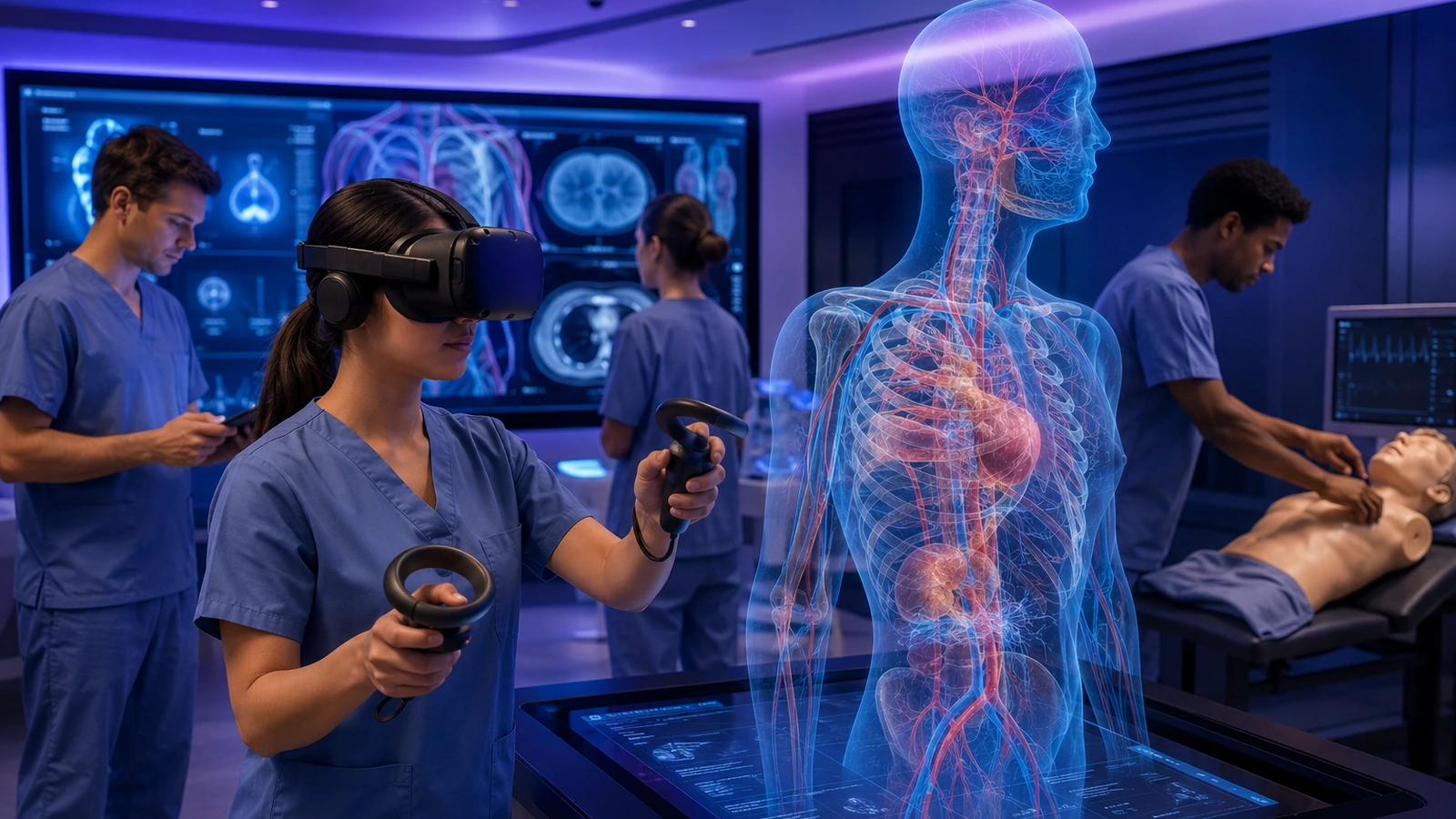
Teaching hospitals and simulation centers rarely struggle to imagine why immersive training could help. They struggle with something more practical: how to make it repeatable. A visually impressive pilot is easy to launch and easy to forget. A workflow that fits faculty time, learner refresh cycles, and operational ownership is much harder to build.
That challenge is becoming more urgent as spatial-computing platforms mature and AI-enabled learning tools move deeper into health and education workflows. Partner organizations do not need more experimental showcases. They need training layers that can be scheduled, repeated, and justified across cohorts.
The direct answer is to treat VR anatomy as a supporting layer inside a broader simulation and refresh-training system. When organizations do that, the pilot becomes easier to scale and easier to evaluate.
Why simulation leaders should care now
The category timing is favorable. Official platform signals from Apple and Meta show continued investment in spatial experiences and enterprise-facing capabilities, while medical-education research keeps supporting the value of immersive and visual learning when it is tied to a clear instructional purpose. The strategic partner opportunity is not to chase novelty. It is to capture repeatable use cases while the market is still defining best practice.
Simulation leaders also face familiar constraints: limited faculty time, uneven learner readiness, and the need to justify new training layers with practical evidence rather than broad promises. That makes repeatability the central design requirement.
A partner that solves repeatability well often creates stronger long-term value than a partner that launches the most visually dramatic pilot.
The operational problem behind many VR pilots
The operational problem behind many VR pilots is ownership. The device arrives, the demo works, learners enjoy it, and then the organization asks who will run it, where it fits in the curriculum, how it connects to remediation or refreshers, and what counts as success. If those questions were not answered before launch, the pilot usually loses momentum.
This is not a VR-specific failure. It is an implementation failure. Training teams need clear use cases, access rules, and handoff points between simulation staff, faculty, and learners. Without that structure, immersive tools become occasional experiences rather than part of a training system.
Hospitals and simulation centers therefore need a model that starts from scheduling and learning flow, not from headset excitement.
A repeatable anatomy-and-simulation layer model
A repeatable anatomy-and-simulation layer model has four parts. First, define the training moment: orientation, refresher, remediation, or pre-simulation preparation. Second, assign ownership between simulation staff and faculty. Third, make the anatomy layer support a recurring operational need, such as spatial refresh before a scenario. Fourth, connect it to a consistent debrief or follow-up routine.
This model works because it gives immersive anatomy a job inside a larger educational sequence. The learner does not just "use VR." They enter a known step in a training pathway. That makes scheduling easier, expectations clearer, and evidence collection more realistic.
Hospitals and centers that work this way are much more likely to keep the technology alive beyond the launch window.
How to build evidence without overselling outcomes
Evidence should be practical and proportionate. Partners do not need to claim that one VR layer transforms all clinical performance. They do need to show whether the anatomy refresher improved readiness, confidence in spatial orientation, or the quality of the subsequent simulation conversation.
That is especially important when working with stakeholders who have seen many edtech promises before. A modest evidence model can still be compelling: usage regularity, repeat participation, faculty satisfaction, learner preparedness, or smoother entry into scenario work. The value of the anatomy layer often lies in making the rest of the training sequence stronger and more efficient.
When organizations measure that honestly, they can scale with more confidence and less hype.
Where MeduTechs fits in a partner workflow
MeduTechs fits well when the partner workflow is framed around immersive anatomy as a repeatable training layer. VR Environments provide the spatial context. AI tutor support can help reinforce explanation or review before or after the session, but the partner story is strongest when the anatomy layer remains tightly connected to the training objective.
That is why faculty-focused anatomy teaching articles are still a useful contextual link even in this lane: simulation adoption succeeds when the educational owner stays visible. The partner conversation should eventually move to explore MeduTechs, but only after the training design is clear.
This is not a one-off hero deployment story. It is a repeatability story.
Common mistakes in hospital and simulation-center adoption
The most common mistake is building the pilot around the device rather than the training gap. The second is failing to define who owns the repeat sessions. The third is overclaiming outcomes too early, which creates internal skepticism and makes later scaling harder.
Another mistake is isolating VR from the surrounding simulation ecosystem. If the anatomy layer does not connect to prep, debrief, or remediation, it becomes easier to cut when schedules tighten.
Strategic partners should think like system builders. The question is not whether the experience is memorable. The question is whether it becomes part of the training rhythm.
What to scope in the first partnership phase
In the first partnership phase, scope one training moment, one owner group, one learner population, and one evidence loop. Keep the pilot narrow enough to repeat and useful enough that teams want the second run.
That approach may feel less dramatic than a big launch, but it is much stronger strategically. Repeatable pilots become programs. One-off showcases become old slide photos.
That is the right mindset for 2026: immersive anatomy as operational training infrastructure, not just a compelling demo.
See faculty-focused anatomy teaching articles for more context from the same audience lane.
If you are designing a repeatable partner rollout, start a MeduTechs partnership conversation for the broader platform view.
Repeatability also matters financially. Simulation leaders often need to justify not only the educational rationale, but also the staff time, scheduling logic, and device utilization behind a program. A narrow but repeatable anatomy layer tends to create a much cleaner operational story than a broad deployment that nobody owns well enough to maintain.
There is a faculty-development angle too. When immersive anatomy is integrated well, instructors and simulation staff build a shared language around where the visual refresher belongs, what learners should do during it, and how it connects to later scenario performance. That shared language is what turns a pilot into part of the center’s training identity.
Strategic partners should therefore think in sequences rather than in scenes. The headset moment is only one scene. The real sequence includes prep, access, facilitation, debrief, reuse, and reporting. If those pieces line up, the partnership can scale thoughtfully. If they do not, even a strong first impression usually fades.
That is the central lesson for this lane. Immersive anatomy earns its place in hospitals and simulation centers when it becomes operationally ordinary in the best sense: scheduled, expected, faculty-backed, and clearly tied to a training objective that returns again and again.
Partnership planning should also include a maintenance conversation from the start. Who updates the learner instructions, refreshes the faculty script, and reviews the evidence loop after the first cohort? Those tasks are easy to ignore in a launch meeting and essential for long-term adoption.
When those maintenance roles are named early, the pilot starts behaving more like a service line than like a gadget test. That is exactly what strategic partners want to see before they expand commitment.
The result is a stronger institutional story. Instead of saying the center experimented with VR anatomy once, the organization can say it now owns a repeatable pre-simulation anatomy layer with clear educational purpose and measurable operating rhythm.
That story also travels better inside complex organizations. Department leads, operations managers, and partnership committees can all understand a repeatable layer model much faster than they can understand an abstract innovation narrative. Clarity at that level is what makes budget conversations, staff planning, and faculty advocacy easier to sustain over multiple cohorts.
For strategic partners, that clarity is often the hidden growth lever. Once the training model is easy to explain internally, it becomes easier to defend, repeat, and extend. It also makes cross-department support easier because everyone can see where the anatomy layer starts, where it ends, and why it is worth repeating.
Sources and further reading
- Efficacy of Virtual Reality and Augmented Reality in Anatomy Education: A Systematic Review and Meta-analysis (2024-09-19; academic) - Immersive Virtual Reality and Augmented Reality in Anatomy Education: A Systematic Review and Meta-analysis (2024-02-12; academic) - Introducing AI Glasses Impact Grants to Advance Wearable Technology for Good (2026-01-21; official) - visionOS 26 Introduces Powerful New Spatial Experiences for Apple Vision Pro (2025-06-09; official) - Introducing OpenAI for Healthcare (2026-01-08; official)
Continue reading
Frequently asked questions
References
- Efficacy of Virtual Reality and Augmented Reality in Anatomy Education: A Systematic Review and Meta-analysisTrust A- VR and AR can improve anatomy knowledge scores when used thoughtfully in education.
- Immersive Virtual Reality and Augmented Reality in Anatomy Education: A Systematic Review and Meta-analysisTrust A- Immersive XR tools help with anatomy learning and student perceptions of usefulness.
- Introducing AI Glasses Impact Grants to Advance Wearable Technology for GoodTrust A- Wearable spatial interfaces are moving from novelty toward applied use cases in care and education.
- visionOS 26 Introduces Powerful New Spatial Experiences for Apple Vision ProTrust A- Spatial computing platforms are adding enterprise APIs and training-friendly capabilities.
- Introducing OpenAI for HealthcareTrust A- Healthcare organizations are moving from generic AI experimentation toward governed, workflow-level deployment.