
Medical schools are being asked to modernize anatomy teaching at the same time they are under pressure to be careful with AI. That combination creates a predictable problem: committees want innovation, faculty want control, students want support, and procurement wants something they can actually manage. If a pilot ignores any one of those groups, the rollout usually stalls.
That tension has sharpened in 2026. European policy language now emphasizes human-centred AI in education, while platform vendors keep pushing more agentic and immersive capabilities into the market. The practical question for a dean or curriculum director is not whether AI and immersive anatomy are real. It is how to structure a pilot so that the institution learns something useful without forcing faculty into an uncontrolled product experiment.
The direct answer is that a medical-school pilot should be built around one defined course workflow, one faculty owner, one measurable student problem, and one tightly managed rollout path. When universities start there, AI and VR anatomy become easier to evaluate as education infrastructure rather than as shiny add-ons.
Why universities are under pressure now
The pressure is structural, not cosmetic. Anatomy remains expensive to teach well, hard to repeat at scale, and difficult to adapt to students who arrive with uneven preparation. At the same time, generic AI tools are already in students’ hands, whether institutions like it or not. That changes the status quo. Schools can either react defensively or shape a better environment with clearer guardrails and stronger learning design.
The March 2026 OpenAI education and learning-outcomes announcements underline a broader shift toward institution-level measurement and training. The May 2026 EU Council conclusions make a parallel point from the policy side: AI should support teacher agency rather than weaken it. Together, those signals support a university strategy built around structured adoption, not laissez-faire usage.
The opportunity is not simply to add more technology. It is to create a better anatomy-learning environment: more repetition, clearer spatial understanding, and better oversight over what students are using when they study, revise, and remediate.

Start with the curriculum problem, not the technology
The first step is to define the educational problem in plain language. Are students struggling with spatial anatomy? Is faculty time disappearing into repetitive clarification? Are cohorts too large for existing lab access? Is remediation inconsistent? A pilot becomes credible when it answers one of those problems directly.
That sounds obvious, but many university pilots start with procurement checklists or vendor demos before anyone agrees on the learning bottleneck. The result is vague success criteria and a weak internal story. Once the initial excitement fades, nobody can say whether the tool underperformed or whether the pilot itself was badly framed.
A better approach is to start with the course map. Pick one block, one cohort, and one practical pain point. Then define what the pilot is supposed to improve operationally or educationally. That gives the technology a job instead of letting it float around as a general promise.
A four-part pilot structure that de-risks adoption
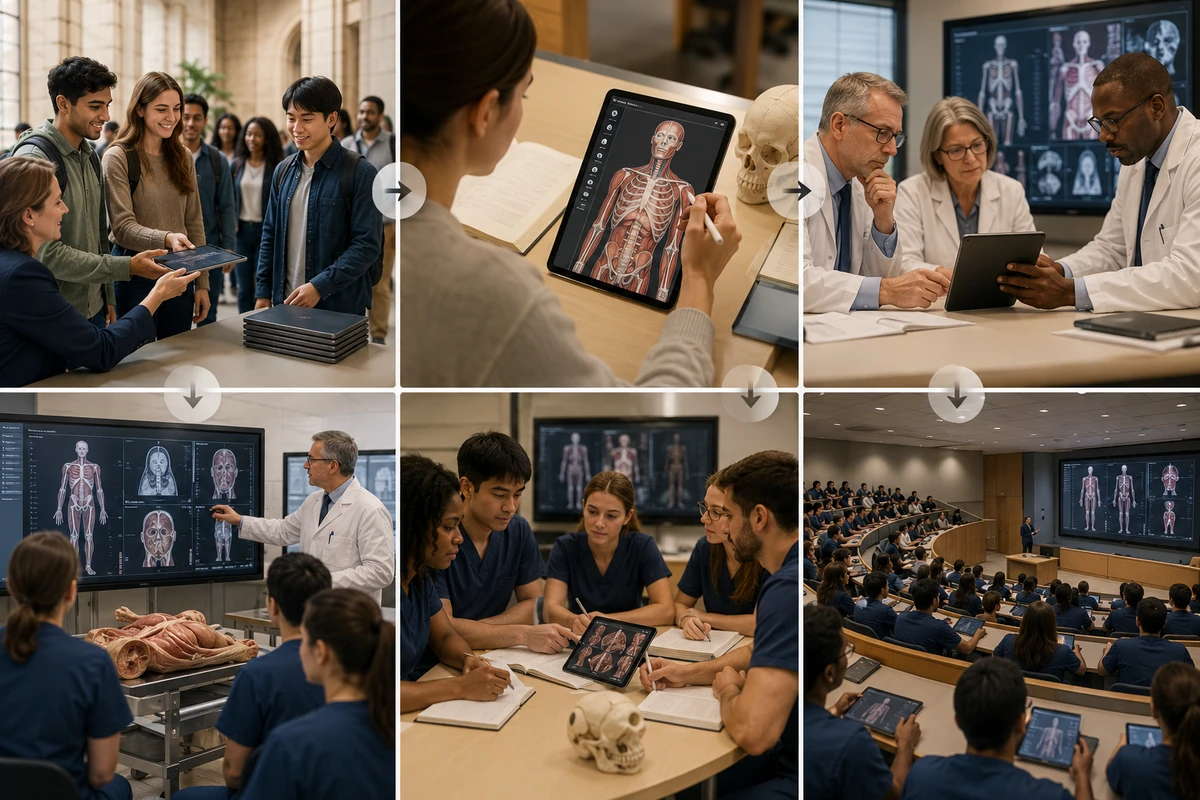
A strong pilot structure has four parts. First, define the course boundary: for example, one anatomy block or one remediation stream. Second, assign faculty ownership so one professor or course lead is accountable for content fit and interpretation. Third, specify the student workflow you want to test, such as pre-lab orientation, post-lab review, or targeted remediation. Fourth, create a simple reporting loop that procurement and leadership can understand.
This keeps the pilot grounded. Students know when and why to use the tool. Faculty know what they are evaluating. Administrators know which licenses matter and where support issues should go. That is much stronger than rolling out a platform campus-wide and hoping adoption patterns reveal the use case later.
The four-part structure also makes comparison easier. You can compare one cohort’s study workflow, support burden, or usage rhythm against a realistic baseline without pretending that a short pilot proves universal outcome gains. That level of honesty builds trust inside the institution.
What faculty ownership should look like in practice
Faculty ownership is the hinge. A university can buy a platform, but professors still decide whether it becomes academically credible. That is why product control matters so much. Faculty need confidence that terminology, emphasis, and explanation style can align with the course rather than compete with it.
In practical terms, faculty ownership means the teaching team can shape how the tool is introduced, where it supports the course, and how students are told to use it. It also means the institution avoids the most dangerous adoption pattern: students improvising their own AI study workflow while faculty remain outside the loop.
That is why faculty-focused anatomy teaching articles are useful context even for university buyers. Faculty adoption is not a side issue. It is the adoption issue. If the teaching team is not part of the design, the pilot may still run, but it will rarely build institutional confidence.
How to measure the pilot without pretending you proved everything
Measurement should be modest, practical, and tied to the problem the pilot was meant to solve. Universities do not need to pretend that one semester proves long-term efficacy across every outcome. They do need a credible evidence plan. That might include usage consistency, reduction in repetitive support requests, student confidence in spatial review, targeted remediation participation, or structured faculty feedback.
What matters is transparency. If the pilot aimed to improve anatomy revision outside limited lab hours, measure that. If it aimed to improve faculty oversight over AI-supported study, measure that. If it aimed to simplify license administration across a defined cohort, measure that too. Procurement and academic leadership often trust a narrow, honest dashboard more than a grand promise.
This is also where the emerging conversation about AI measurement becomes helpful. OpenAI’s March 4, 2026 learning-outcomes work reinforces a simple lesson: institutions need ways to track learning processes, not just end scores. Medical schools can apply that principle even in a small pilot.
Where MeduTechs fits in a university rollout
MeduTechs fits best when the university use case is described as a controlled anatomy-learning workflow, not a broad AI replacement for teaching. The explore MeduTechs landing flow should come after the institution understands the pilot structure: who owns it, which cohort uses it, and what the rollout is meant to prove.
The University Panel is especially relevant because it gives the rollout an operational spine. License Management keeps the pilot bounded. Bulk User Import reduces onboarding friction. The Professor Web Portal gives faculty a meaningful role instead of leaving the academic layer disconnected from the administrative one.
That combination matters because universities buy systems, not isolated screens. A platform earns credibility when the teaching workflow and the administrative workflow fit together cleanly.
Common rollout mistakes and what to do next
The most common rollout mistake is starting too wide. A second mistake is pitching the technology as a substitute for faculty instead of as a way to strengthen a course design. A third is asking for perfect proof too early, which usually pushes teams into inflated claims or vague storytelling.
A better next step is straightforward: pick one course boundary, one faculty owner, one student pain point, and one reporting loop. Then run the smallest pilot that can still teach the institution something useful. That is how universities move from interest to evidence without turning governance into a bottleneck.
In 2026, the schools that win this transition will not be the ones that move fastest at random. They will be the ones that build AI and immersive anatomy into a disciplined teaching system that faculty and administrators can both trust.

See faculty-focused anatomy teaching articles for more context from the same audience lane.
If your institution is shaping a pilot now, start a university pilot conversation to review the MeduTechs approach.
One more university reality deserves attention: pilots are often judged by how much administrative uncertainty they create, not just by how impressive the learning layer looks. That is why a bounded rollout, predictable onboarding, and a faculty-owned communication plan matter so much. When the digital learning team, procurement lead, and course director can all explain the pilot in the same sentence, the institution is far more likely to move from a test to a lasting deployment. In other words, governance clarity is not separate from educational value. In this market, it is part of the value.
Sources and further reading
- Ensuring AI Use in Education Leads to Opportunity (2026-03-05; official) - New Tools for Understanding AI and Learning Outcomes (2026-03-04; official) - AI in Education: Council Calls for Human-Centred Approach (2026-05-11; official) - Rules for Trustworthy Artificial Intelligence in the EU (2025-02-02; official) - Efficacy of Virtual Reality and Augmented Reality in Anatomy Education: A Systematic Review and Meta-analysis (2024-09-19; academic) - The Medical Education Platform for Medical Schools (2026-01-01; company)
Continue reading
Frequently asked questions
References
- Ensuring AI Use in Education Leads to OpportunityTrust A- Institutions are shifting from broad AI access to structured educational use with training and governance.
- New Tools for Understanding AI and Learning OutcomesTrust A- Education leaders now need ways to measure how AI changes learning processes, not just exam scores.
- AI in Education: Council Calls for Human-Centred ApproachTrust A- European policymakers want AI in education to preserve teacher agency, safety, and inclusion.
- Rules for Trustworthy Artificial Intelligence in the EUTrust A- AI literacy obligations are already active, with broader AI Act application beginning on 2026-08-02.
- Efficacy of Virtual Reality and Augmented Reality in Anatomy Education: A Systematic Review and Meta-analysisTrust A- VR and AR can improve anatomy knowledge scores when used thoughtfully in education.
- The Medical Education Platform for Medical SchoolsTrust B- Institutional buyers want data visibility, assignment control, and curriculum fit, not just content access.