
How Doctors Can Use Anatomy Visuals to Improve Patient Understanding
Good clinical explanations do not fail because doctors lack expertise. They fail because expertise is not automatically visible to the patient. A clinician may have a crystal-clear mental map of a joint, nerve path, or procedure route, while the patient is still trying to picture where the problem even sits.
The goal is understanding, not demonstration
An anatomy visual can easily become performative. The doctor opens a beautiful model, rotates it, names structures accurately, and feels that the explanation was strong. But if the patient cannot explain back the core point, the tool became a demonstration instead of a communication aid.
That is the first mindset shift. The visual is not there to prove expertise. It is there to help the patient form a usable mental picture.
If the patient leaves still unable to describe the core issue in everyday language, the conversation may have been detailed but it was not yet effective.
If the patient leaves still unable to describe the key structure, route, or choice in everyday language, the room had a demonstration but not an understanding moment.
A simple clinician workflow that works in real rooms
1. Frame the one question
What does the patient need to understand before they leave this moment? Not the whole anatomy. One core point.
2. Show the structure plainly
Use a visual that reduces complexity, not increases it. If the image introduces five new labels, the explanation is already drifting.
3. Translate the terminology
Move from professional language to patient-facing language without losing precision. This step is harder than it sounds, because clinicians often think in one terminology layer and speak in another.
4. Ask for teach-back
Have the patient explain what they understood while the visual remains visible. This is where comprehension becomes observable.

In practice that can be as direct as, “Show me where you think the problem is now,” or “Can you tell me what this means for the procedure in your own words?” Those questions make the explanation accountable instead of assumed.
Clinicians often worry that this will slow the visit down. In reality it usually prevents a second, more expensive explanation later because the misunderstanding appears before the visit ends.
In real practice that may sound simple: “Show me where you think the problem is now,” or “Can you tell me what this means for the procedure in your own words?” Those questions make the explanation accountable.
The hidden risk: too much detail too early
Doctors sometimes over-explain because they want to be helpful. But more anatomy is not always better anatomy communication.
That is why strong patient explanations often sound simpler than the doctor's internal reasoning. The clinician still holds the full anatomy, but only the part that changes this patient's decision or next step needs to surface.
That is why excellent patient explanations often sound simpler than the clinician's internal reasoning. The doctor keeps the complexity in mind, but only the portion that changes understanding reaches the patient.
Why terminology switching matters so much
One under-discussed problem in patient explanation is terminology mismatch. A clinician may need the exact structure name for internal accuracy, while the patient needs a simpler description to follow the logic of the explanation.
That is why a nomenclature shift can be genuinely useful. It helps the doctor keep one accurate anatomy view while changing the language level to suit the conversation. Done well, that keeps the explanation precise without making it inaccessible.
Where MeduTechs becomes practical for doctors
This is the point where MeduTechs fits naturally. The value is not that the app can show a lot. The value is that it can help a doctor show less, better.
For this audience, the Nomenclature Toggle is the most relevant feature because it supports the move between professional and patient-friendly explanation. Supporting tools like Part Isolation help when the structure needs to be simplified visually before it is simplified verbally.
The MeduTechs clinic audience page belongs naturally in this conversation because the use case is patient explanation, not broad consumer learning.
The contextual CTA here is practical: before you adopt any anatomy visual tool in clinic, define the single explanation moment where you most often lose patient understanding.
For some doctors that moment comes before a procedure. For others it appears when a patient needs to understand referred pain, movement restriction, or why a rehab step matters anatomically. The narrower the moment, the stronger the workflow.
For some clinicians that will be before a procedure. For others it will be the moment a patient needs to understand why a symptom radiates, why one movement matters, or what structure is actually involved.
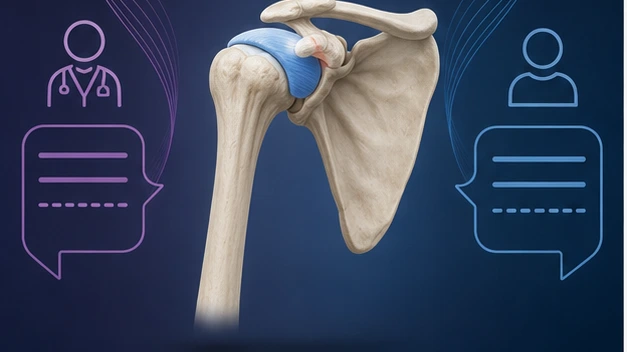
A consent-friendly explanation habit
AHRQ's informed-choice materials are a useful reminder that understanding is central to informed decisions. A visual tool does not replace the consent process, but it can strengthen the part where patients need to picture the anatomy and connect it to the proposed action.
That is especially helpful when the patient is anxious, unfamiliar with the body region, or trying to compare options. A clearer mental picture often leads to better questions and a more honest conversation about what the patient is agreeing to.
It also reduces the pressure on the doctor to invent a perfect analogy on the fly. The visual keeps the shared reference point in the room while the doctor focuses on meaning and action.
This matters in routine medicine too, not just procedural consent. Follow-up adherence, home exercise accuracy, and symptom monitoring all improve when the patient actually knows what part of the body the clinician means and why that location matters.
What not to do in front of patients
- Do not show more anatomy than the moment requires - Do not rely on jargon-heavy labels alone - Do not assume nodding equals understanding - Do not use the visual to speed past the teach-back moment - Do not turn the explanation into a generic app demo
One extra self-check helps: ask whether the patient could explain the main point to a family member on the way home. If probably not, the explanation still needs another pass.
That question also keeps the doctor honest about the purpose of the visual. The goal is not to impress the patient with detail. The goal is to leave behind a clearer story they can carry out of the room.
When that happens, the visual has done its job. It has turned anatomy from something the doctor knows into something the patient can actually use.
That is a much better standard than whether the screen looked impressive.
The memorable insight
The anatomy visual is not the message. It is the bridge. If the patient cannot cross it in their own words, the explanation is not finished.
Sources and further reading
- AHRQ, “Teach-Back” - AHRQ, “Patient Education and Engagement” - AHRQ, “Plain Language at AHRQ” - AHRQ, “Making Informed Consent an Informed Choice”