
A Retrieval-First Anatomy Study Routine That Uses AI Without Letting It Think for You
The fastest way to feel productive in anatomy is also the fastest way to get blindsided by the exam.
Ask a chatbot for an explanation, read a polished answer, nod along, and move on. It feels efficient. It also hides the one thing that actually matters: whether you could have retrieved, oriented, and connected the anatomy yourself before the answer appeared.
That is why a useful AI study routine for medical students has to begin with retrieval, not convenience.
Why students need a new routine, not a new shortcut
Students are already using AI. That part is settled. What matters now is whether AI becomes a scaffold for deeper understanding or a machine for borrowed confidence. OpenAI's 2026 learning-outcomes work is useful precisely because it focuses on how students learn with AI over time, not just whether a tool can respond well in a single moment.
Medical education research points in the same direction. AI can support learning, but the evidence base is still developing, and the difference between guidance and overreliance is not a minor detail. In anatomy, where spatial understanding is central, that difference becomes obvious fast.
If your study routine starts with AI answers, you often end up testing recognition instead of knowledge. You can tell when that is happening because you feel smooth during revision and slow during recall.
The problem most students misdiagnose
Students often think their issue is that they need better explanations. Usually they need better effort sequencing.
You do not necessarily need more information on the brachial plexus, the inguinal canal, or the branches of the external carotid artery. You need a better loop for forcing yourself to retrieve, compare, and reconstruct the anatomy before you check what you missed.
That is why retrieval-first routines tend to feel worse in the moment and better on exam week. They expose weakness earlier.

The four-step retrieval-first loop
Here is a routine that works better than open-ended AI browsing.
Step 1: attempt before you ask
Pick one structure set or region. On paper or in notes, list what you know first: boundaries, branches, blood supply, innervation, relationships, or key functions.
Step 2: test the structure spatially
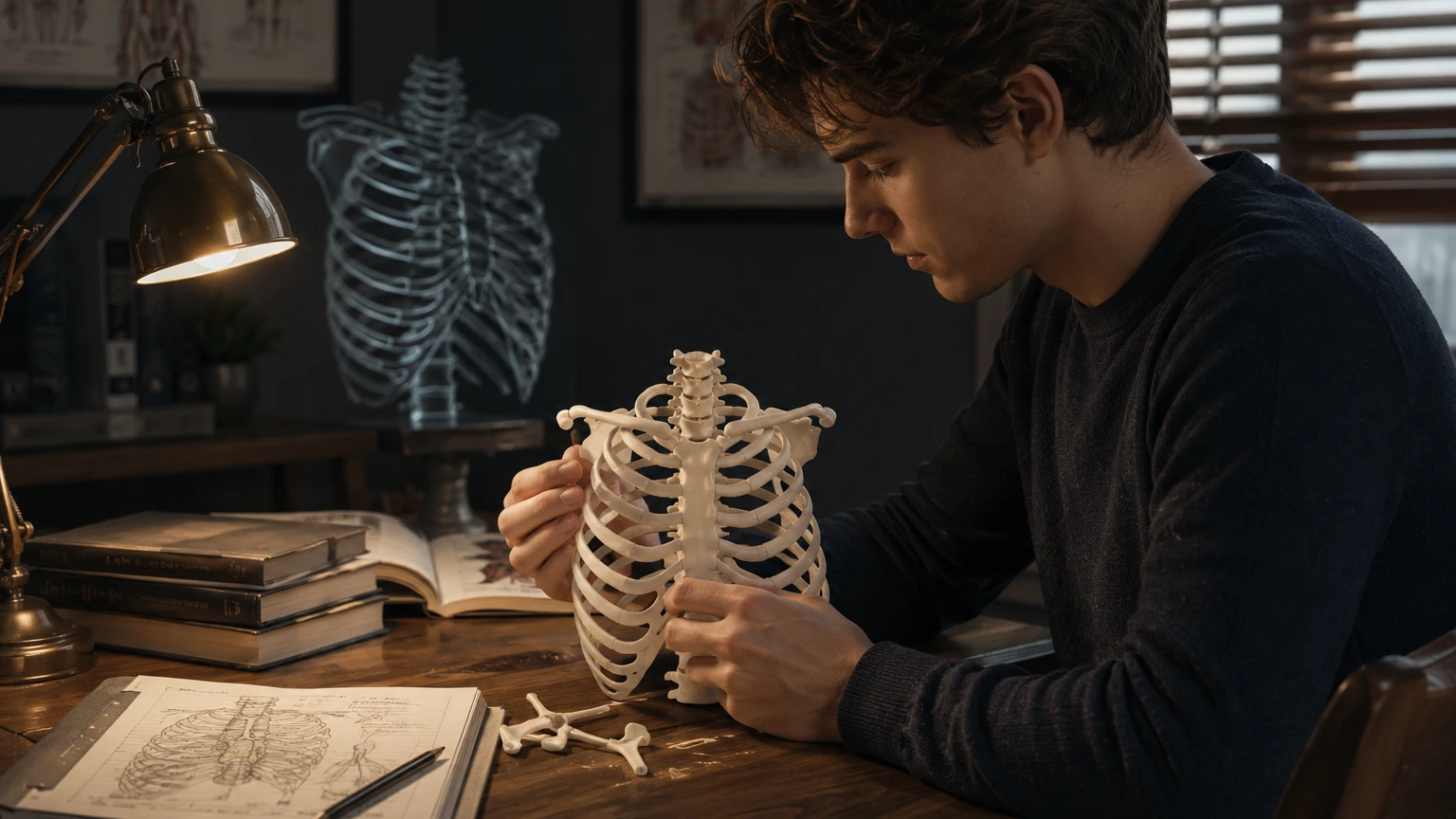
Before reading an explanation, orient the anatomy in 3D. Ask yourself what lies anterior, posterior, medial, lateral, superficial, or deep.
Step 3: use AI only to check the gap
This is the right moment for help. Ask a narrow question about what you missed or confused. Do not start with "teach me everything." Start with the exact failure point.
Step 4: close the loop without the AI
Hide the answer. Rebuild the explanation yourself. If you cannot do that, the session was exposure, not learning.
That fourth step is the one students skip most often.
Why anatomy especially punishes passive AI use
Anatomy is not just about correct sentences. It is about mentally handling depth, sequence, and relation. That is why students can perform well on explanation-heavy review and still freeze on unlabeled practical material or imaging-based prompts.
Recent work on spatial skills in anatomy reinforces the point that this part of learning is malleable. In plain language: the brain gets better at spatial anatomy when you actually practice spatial anatomy. AI cannot do that part for you.
So the question to ask after every session is simple: did the tool help me think, or did it help me stop thinking sooner?
Where MeduTechs becomes genuinely useful
This is where a structure-anchored tool beats a general chatbot tab.
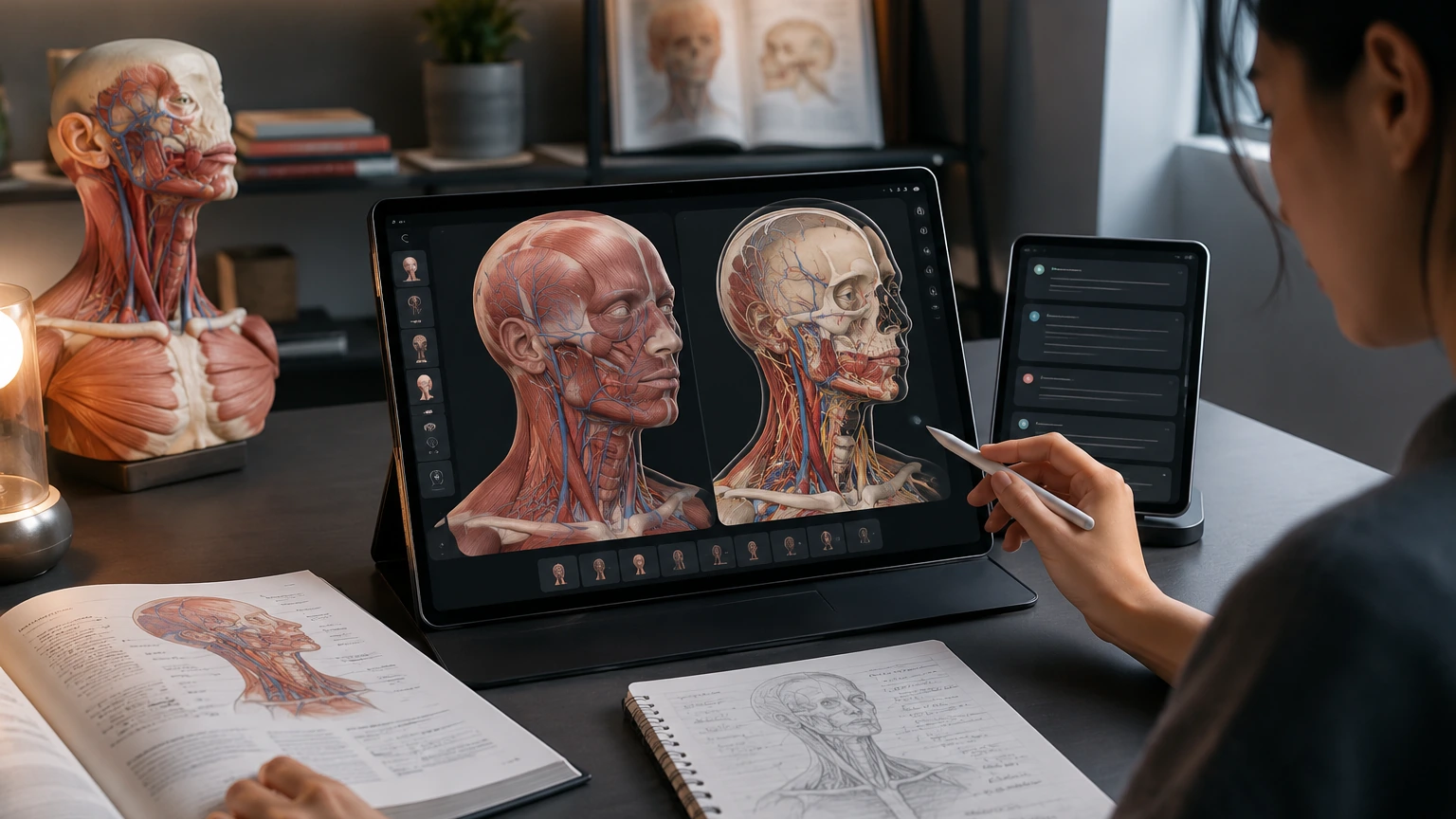
The most useful MeduTechs feature for this lane is Hide-Unhide. It forces a better kind of review because you can peel back layers and test whether you still know what sits underneath, what travels together, and what changes when the superficial anatomy disappears. Supporting features like Universal Search and a system-based learning path are helpful because they reduce friction without removing the need to orient yourself.
If you want more study-focused follow-on reading, the MeduTechs medical student study guides are the natural internal next stop.
The common mistake or hidden risk
The hidden risk is using AI to create a feeling of momentum. It is especially tempting when you are tired. You ask for a summary, get a tidy answer, and mistake fluency for progress.
Watch for these warning signs:
- you rarely try to explain first - you are reading more than you are reconstructing - you ask broad prompts instead of narrow correction prompts - you feel strong until the answer disappears
If those patterns show up, the fix is not more discipline in the abstract. The fix is a tighter routine.
A practical weekly anatomy workflow
Use this across a five-day block:
Day 1
Preview the region or system and build a first-pass structure map.
Day 2
Run retrieval from memory and use AI only to correct specific misunderstandings.
Day 3
Study in layers. Hide and reveal structures while narrating their relationships aloud.
Day 4
Do a mixed recall session with unlabeled prompts or imaging comparisons.
Day 5
Rebuild the whole topic without help. Then use AI or notes only for the final correction pass.
That sequence protects the one thing you cannot borrow on exam day: your own recall.
One memorable rule to keep
If the answer showed up before your struggle did, the study session was probably too easy to stick.
That is the routine-level mindset shift students need right now. AI is most valuable when it sharpens the struggle productively, not when it removes it.
For students under time pressure, this also creates a useful filter. On days when you only have twenty minutes, it is still better to run one retrieval loop properly than to skim three polished explanations and remember almost none of them tomorrow.
That mindset protects you from one of the biggest AI-era study traps: measuring effort by how much content passed in front of your eyes instead of by how much anatomy you can now rebuild from memory.
Once you start measuring sessions that way, your study decisions get sharper fast.
It also makes it easier to stop wasting time on revision methods that feel comforting but leave no durable trace.
That is the kind of honesty good exam preparation needs.
One example of a better prompt
Bad prompt: "Explain the brachial plexus simply."
Better prompt after retrieval: "I keep confusing the posterior cord branches and how they relate to the axillary and radial nerves. Compare them using only the relations I would need for a practical exam and then quiz me with two recall checks."
How to know the routine is working
By the end of a good week, you should notice that your prompts are getting narrower because your weak spots are clearer, and that reconstruction feels faster even when the model is hidden.
You should also notice a change in how frustration feels. Instead of broad anxiety about "anatomy," the struggle becomes local and specific: one branch pattern, one boundary, one imaging orientation mistake. That is good news, because specific confusion is much easier to repair than vague overwhelm.
Once your weak spots get that specific, AI becomes a better assistant because it has a narrower job to do.
Sources and further reading
- New tools for understanding AI and learning outcomes - ChatGPT as a Learning Tool for Medical Students: Results From a Randomized Controlled Trial - Medical students' attitudes toward AI in education: perception, effectiveness, and its credibility - Exploring the potential malleability of spatial skills through anatomy teaching
Continue reading
Frequently asked questions
References
- New tools for understanding AI and learning outcomesTrust A
- ChatGPT as a Learning Tool for Medical Students: Results From a Randomized Controlled TrialTrust A
- Medical students' attitudes toward AI in education: perception, effectiveness, and its credibilityTrust A
- Exploring the potential malleability of spatial skills through anatomy teaching: A quantitative study among medical studentsTrust A