
Medical students do not need more anatomy content. They need a better way to move between seeing, recalling, and applying it. That is why so many students feel simultaneously overwhelmed and underprepared. They spend hours reviewing material, yet the structure disappears the moment a practical question or viva-style prompt forces them to reconstruct it from memory.
AI makes that tension sharper. A good answer can arrive in seconds, but the speed is deceptive. If the tool explains everything before the student has attempted retrieval, the brain gets comfort instead of durable learning. That is useful in the short term and dangerous over a long block.
The direct answer is to build a retrieval-first routine: try to recall, then check, then rebuild the structure visually, then test again. AI and 3D tools become powerful only when they support that loop instead of replacing it.
Why AI can make anatomy study easier and weaker at the same time
The current research conversation points in that direction. Reviews of generative AI in health professional education keep highlighting opportunity alongside the need for thoughtful use. The retrieval-practice review from 2025 says the quiet part out loud: recall-based study methods still matter because they create stronger learning than passive review.
Students already feel this even if they do not phrase it that way. They know the difference between a night that felt productive and a morning when nothing is actually accessible under pressure. Anatomy punishes false familiarity, especially when spatial relationships are involved.
That is why the best study routine is not the one that feels easiest in the moment. It is the one that keeps turning recognition into explanation.

A real study scenario before the exam block
Imagine a student preparing for a brachial plexus review after a heavy week of lectures. They have slides, notes, and a chatbot tab open. The temptation is obvious: ask for a simple explanation, read it, feel calmer, and move on. But the next day they still cannot reconstruct the branches or explain which relationships matter clinically.
The issue is not that the explanation was wrong. The issue is that the student never tried to retrieve the map first. Without that effort, the explanation sits on top of the knowledge instead of building it.
A better routine starts with discomfort. Try to draw the pathway, name the structures, or explain the region aloud before you ask for help. That first attempt tells you what the real gap is.
The retrieval-first routine that works better
A strong retrieval-first routine has four stages. First, attempt recall from memory with a blank page, quick sketch, or spoken explanation. Second, use a trusted tool to check what was missed. Third, move into a 3D or layered visual to correct the spatial map. Fourth, close the tool and retrieve again.
That sequence works because every stage has a job. The first exposes the gap. The second gives targeted correction. The third turns the abstract fix into a spatial image. The fourth tests whether the understanding now belongs to you rather than to the screen.
Students can adapt the timing, but the order matters. If you start with the answer, the whole loop gets weaker.
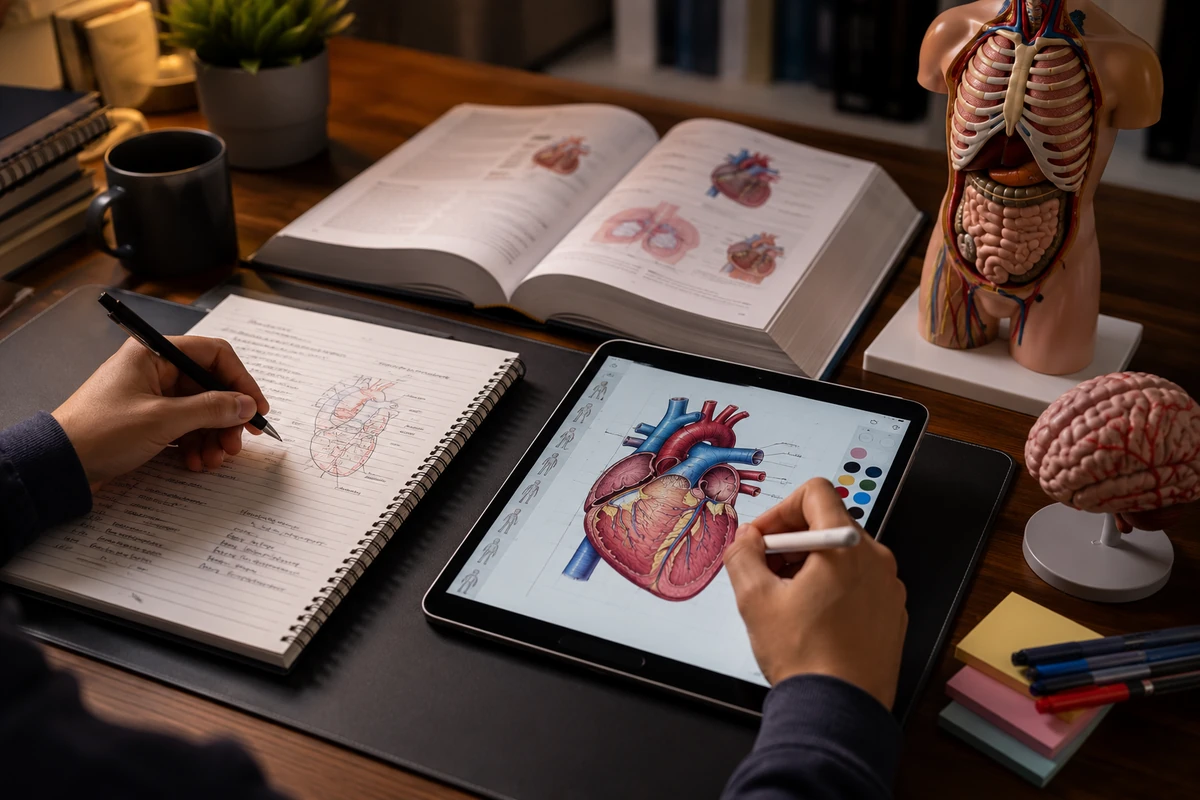
How 3D anatomy should fit into the loop
This is where 3D anatomy becomes more than a nice visual. A good 3D tool helps students rebuild the structure after retrieval failure. The point is not to stare at a perfect model for ten minutes. The point is to use the model to understand what you could not reconstruct alone, then step away and try again.
Systemic learning paths are especially useful because they keep structures inside a meaningful pattern rather than turning revision into isolated facts. When students can move through one system at a time, they are more likely to grasp relations that survive outside the original slide deck.
For broader student context, the medical student study guides audience page is the natural internal link because it keeps the reader inside the same study-problem cluster.
Where MeduTechs becomes useful without becoming a crutch
MeduTechs fits naturally when the tool is used as a second-stage correction and visualization layer. The Mobile App is strongest when it helps a student test what they know, inspect the 3D relationship they missed, and then return to retrieval. AR Anatomy can make the model feel more tangible, while Universal Search reduces friction when the exact structure is hard to locate quickly.
Notice what is not happening here: the platform is not being asked to become the student’s entire thinking process. It is being used to make the hard parts clearer, faster, and more memorable.
If that workflow sounds useful, explore MeduTechs after the study method is clear. The routine comes first; the product earns its place inside it.
Common study mistakes students make with AI
The first common mistake is opening AI before attempting recall. The second is using 3D anatomy only as a passive viewer instead of as a correction tool. The third is jumping between too many resources, which creates the feeling of work without enough repetition inside one structure map.
Another mistake is confusing search convenience with comprehension. Being able to find the structure instantly does not mean you can explain it under exam pressure. Students need to protect that distinction if they want their study time to compound.
The goal is not to avoid AI. It is to stop AI from stealing the most important learning step.
What to do in your next study session
In your next study session, pick one region, try to reconstruct it cold, check only what you missed, rebuild the spatial map in 3D, and then repeat the recall without the screen. That is a small routine, but it creates the right kind of friction.
Over a semester, those loops add up. They reduce the panic that comes from knowing you have seen everything but cannot retrieve it when it counts. They also make AI feel more like a coach and less like borrowed intelligence.
That is the version of AI-supported studying worth keeping in medicine.

See medical student study guides for more context from the same audience lane.
If this study routine feels useful, explore MeduTechs for anatomy learning workflows for the product side.
Students who adopt this routine consistently also gain a psychological advantage. They stop asking whether they studied enough in the abstract and start asking whether they can retrieve the concept under pressure. That shift makes revision calmer because progress becomes visible. Instead of chasing endless resources, the learner can see whether the same weakness still appears after another retrieval round.
Sources and further reading
- The Impact of Generative AI on Health Professional Education: A Systematic Review in the Context of Student Learning (2025-06-18; academic) - The Use of Retrieval Practice in the Health Professions: A State-of-the-Art Review (2025-07-17; academic) - Efficacy of Virtual Reality and Augmented Reality in Anatomy Education: A Systematic Review and Meta-analysis (2024-09-19; academic) - New Tools for Understanding AI and Learning Outcomes (2026-03-04; official)
Continue reading
Frequently asked questions
References
- The Impact of Generative AI on Health Professional Education: A Systematic Review in the Context of Student LearningTrust A- Students are already using GenAI across multiple learning modes, but thoughtful integration matters.
- The Use of Retrieval Practice in the Health Professions: A State-of-the-Art ReviewTrust A- Retrieval practice remains one of the strongest learning methods in health professions education.
- Efficacy of Virtual Reality and Augmented Reality in Anatomy Education: A Systematic Review and Meta-analysisTrust A- VR and AR can improve anatomy knowledge scores when used thoughtfully in education.
- New Tools for Understanding AI and Learning OutcomesTrust A- Education leaders now need ways to measure how AI changes learning processes, not just exam scores.