
A Retrieval-First Anatomy Study Loop for the AI Era
If AI makes anatomy feel easier, that can be a gift or a trap. The difference is whether your study loop still forces you to retrieve, locate, and explain.
A lot of medical students now have the same study problem in disguise: they feel productive because AI makes the session feel smooth. The answer appears quickly. The explanation sounds complete. The notes look better. Then a tutor asks for the nerve pathway or the contents of a region, and the certainty falls apart.
That tension is exactly why the learning-first AI conversation matters. OpenAI’s July 29, 2025 study mode announcement focused on step-by-step guidance rather than instant answers, and Google’s January 15, 2026 global AI survey found that learning had become the top reason people use AI. In other words, the tools are now normal. The challenge is building a study loop that still produces real recall.
If you want more MeduTechs content for this audience, these medical student study guides are a good side route. For the next hour of study, though, the goal is simple: use AI to structure your work without letting it do the remembering for you.
The direct answer is that anatomy study should stay retrieval-first. AI can help shape the session, but your routine still needs closed-book recall, spatial checking, and correction.
Why Smooth Study Sessions Can Still Be Weak
A productive-feeling anatomy session is not always a productive one. Recognition feels good. Reading a tidy explanation feels good. Asking a chatbot to summarize the brachial plexus feels efficient. None of that guarantees you can retrieve the information or use it under pressure.

That is why the AI era changes study hygiene. The old risk was passively rereading notes. The new risk is passively consuming high-quality explanations and mistaking that ease for learning.
The fix is not to avoid AI. The fix is to place AI inside a routine that still forces recall, spatial checking, and correction.
A Familiar Student Scenario
You sit down to review pelvic anatomy. You ask AI for a structured summary. It gives you a clean answer. You understand it while reading. Then you close the tab and try to reconstruct the same region from memory and realize you cannot place the vessels relative to the nerves with any confidence.
This happens because understanding during input is not the same as retrieval after input. Anatomy especially exposes this gap because the material depends on relationships, not isolated facts.
Once you see the difference, you can design around it. The session should create moments where you have to prove the structure is in your head before the tool helps you clean it up.
The Retrieval-First Anatomy Study Loop
Start with a narrow target: one region, one pathway, or one system segment. Write or say what you know before opening help.
Next, test yourself on location and relationship. What is superficial? What is deep? What passes through? What is adjacent? This is where anatomy often reveals weak points.
Then open a controlled 3D or explanation layer to check the exact structure. Use the tool to correct, not to replace the attempt.
Finally, close the view and explain the region again in your own words. That last step matters because it turns corrected understanding into active retrieval.
One Common Mistake To Avoid
Do not use AI only when you are already confused. Use it after an attempt. If you skip the attempt, you lose the diagnostic value of the session.
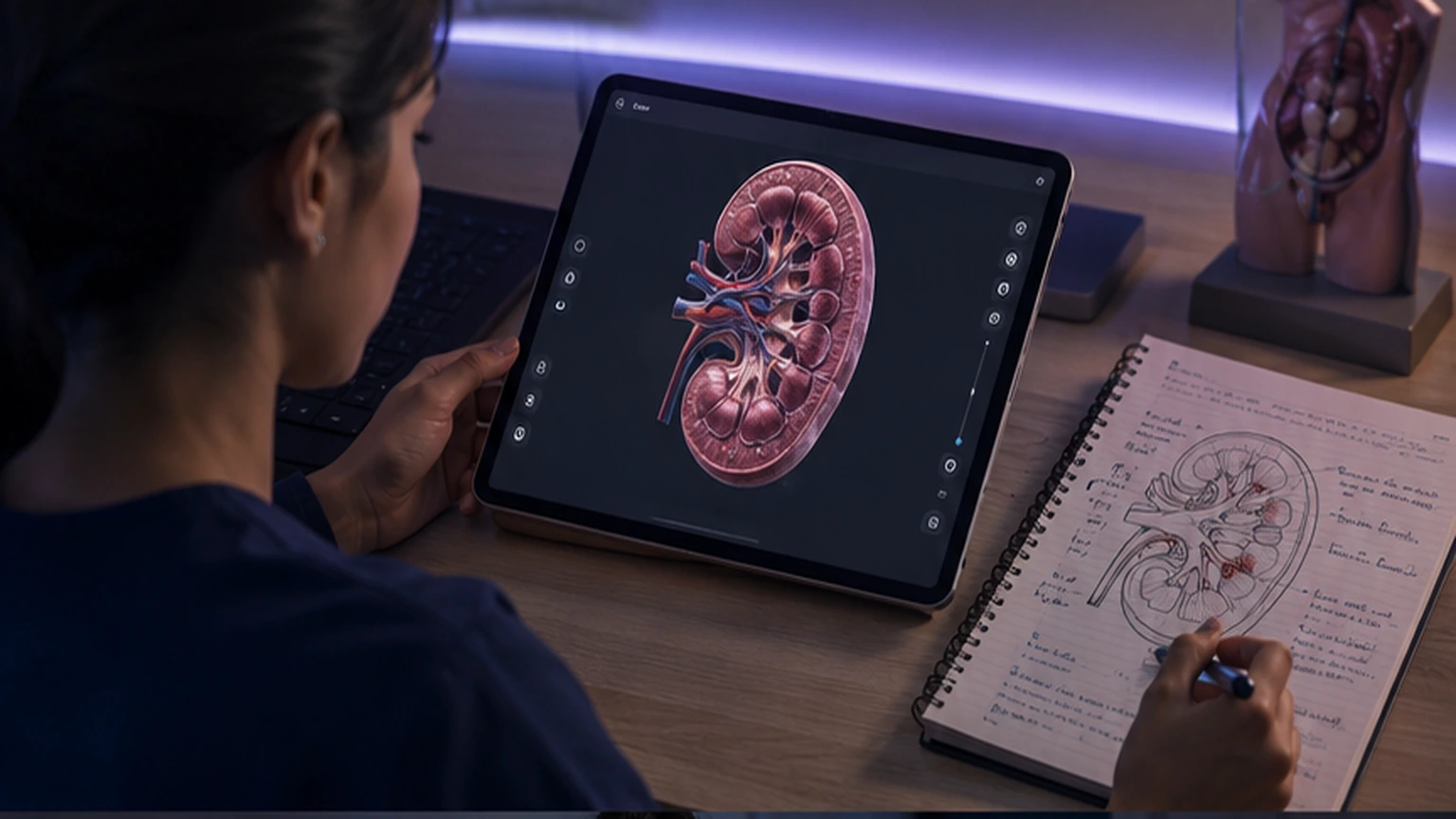
Also avoid switching too fast between too many topics. AI makes it easy to jump around because every answer feels accessible. Anatomy retention usually improves when the loop stays focused long enough to force structure, correction, and re-expression.
Where A Controlled 3D Layer Helps
This is where a pocket anatomy lab becomes valuable. The point is not to add more content. The point is to verify whether the anatomy in your head matches the structure on the screen.
A tool like MeduTechs becomes useful when you need to isolate the structure, search it quickly, and compare your recall against a clearer visual model without slipping into passive consumption.
If you want more student-focused reading around this topic, browse these medical student study guides. The routine still comes first: recall, check, correct, explain.
A Better Way To Use AI Tonight
Before your next anatomy block, choose one region and run the loop once without multitasking. Measure success by what you can retrieve after the explanation, not by how neat the explanation sounded while you were reading it.
If the loop feels slower than your old routine, that is often a good sign. Durable study is usually slightly more effortful than fake progress.
When you want a focused tool to support that workflow, explore MeduTechs and judge it by whether it makes recall checking easier, not just prettier.
You can also scale the loop across the week without making it mechanical. Use one short region-based session, one pathway-based session, and one integration session that forces you to connect anatomy to symptoms or procedures. The point is to keep recall active while changing the way you test it.
Another helpful habit is to log where the loop breaks. Did you fail at naming, locating, sequencing, or explaining? Anatomy weaknesses feel similar when you are frustrated, but they respond to different corrections. A weak naming problem needs different work than a weak spatial-mapping problem.
Students who improve fastest often make their corrections visible. They sketch, label, speak out loud, or write short contrasts such as 'median nerve versus ulnar nerve in this region.' That extra effort creates friction, but it also reveals whether the study session changed your memory or just your mood.
If you use AI inside this loop, let it sharpen the next question rather than close the session. A good AI interaction ends with a better retrieval challenge, not with a comfortable sense that the topic is done.
That is also why short self-tests after the loop matter. If you cannot reconstruct the region or pathway five minutes later without help, the session still belongs in the correction phase rather than the mastery phase.
Over a semester, this habit changes confidence quality. Instead of trusting whatever felt clear while you were reading, you start trusting what you can rebuild after the tool is closed.
That is the kind of confidence anatomy exams and clinical application reward: not borrowed fluency, but durable structure in your own head.
Once students feel that difference a few times, the study loop stops feeling restrictive and starts feeling like the fastest route to real control.

Sources And Further Reading
-
Introducing study mode (2025-07-29; official company blog)
-
Learners and educators are AI’s new “super users” (2026-01-15; official company blog)
-
Effectiveness of virtual reality on medical students’ academic achievement in anatomy: systematic review (2024-12-02; peer-reviewed article)
-
Immersive Virtual Reality and Augmented Reality in Anatomy Education: A Systematic Review and Meta-Analysis (2024-02-12; academic index record)
Continue reading
Frequently asked questions
References
- Introducing study modeTrust A
- Learners and educators are AI’s new “super users”Trust A
- Effectiveness of virtual reality on medical students’ academic achievement in anatomy: systematic reviewTrust A
- Immersive Virtual Reality and Augmented Reality in Anatomy Education: A Systematic Review and Meta-AnalysisTrust A