
A Practical Anatomy Explanation Workflow for Clinics
Patients rarely need more words. They usually need the anatomy made visible, simple, and relevant to the decision in front of them.
A patient leaves a short consultation saying, “Okay, I get it,” and then asks the receptionist the same question three minutes later. That does not always mean they were inattentive. Often it means the anatomy never became real enough to hold onto.
As AI explanation becomes normal, the communication bar is rising. Patients are arriving with generated summaries, forum screenshots, and half-understood terminology. Clinics still need a faster, clearer way to turn abstract anatomy into something a patient can picture and repeat back.
For more clinic-oriented background, the clinic anatomy explanation articles page is helpful. But the practical question inside the room is narrower: how do you explain one structure, one mechanism, and one next step without turning the consultation into a lecture?
Why Short Visits Make Anatomy Hard To Explain
Time pressure changes the anatomy explanation challenge. Clinicians often know exactly what they mean, but patients are hearing unfamiliar words while stressed, uncomfortable, and focused on the practical consequence of the visit.
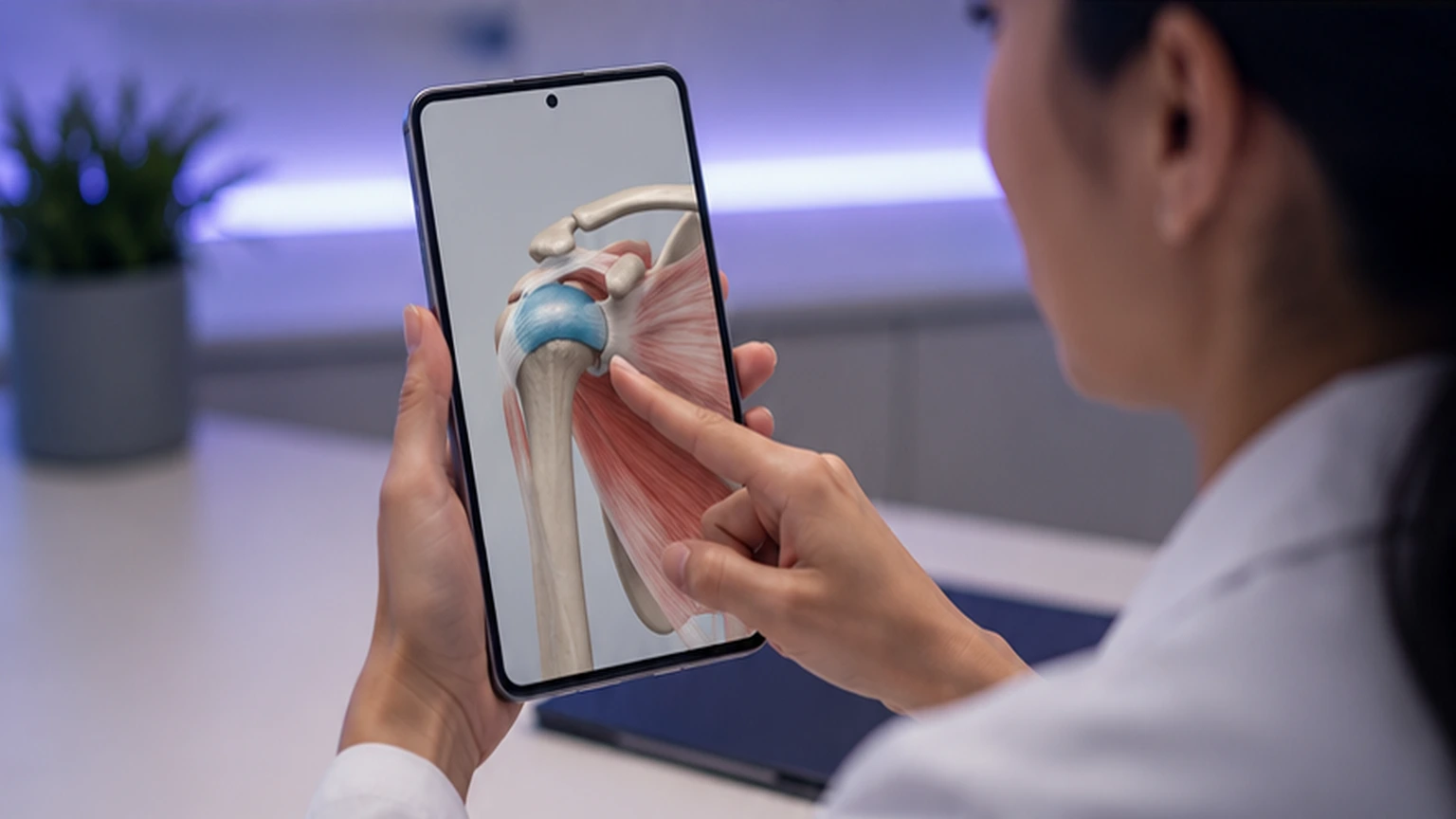
That is why explanations break down even when they are technically correct. Patients do not just need more information. They need a simpler mental picture of what is happening and why the next step follows from it.
A short-visit workflow accepts that constraint. It does not try to teach a mini-course. It aims to make one part of the anatomy visible enough that the patient can understand the mechanism and repeat the plan back in plain language.
A Real Consultation Scenario
Think about a shoulder pain consultation. The patient has heard “rotator cuff,” “impingement,” and maybe “bursa,” but those words do not live anywhere clear in their mind. They only know movement hurts and they want to know whether the problem is serious.
If the clinician stays verbal, the patient may nod without anchoring anything. If the clinician can show the key structure, isolate it, and connect it to the movement that reproduces pain, the conversation becomes much easier to retain.
This is exactly where a mobile anatomy support tool is more practical than a long handout. The explanation happens in the room, in the moment, while attention is still focused on the decision being discussed.
The Four-Step Patient Explanation Workflow
Step one: orient the patient in plain language. Name the region, not the full lecture. Tell them what you are about to show.
Step two: isolate one structure or pathway. This matters because clutter destroys understanding. The patient does not need the entire shoulder, spine, or pelvis at once.
Step three: connect anatomy to their symptom or decision. Explain what the structure does, what is irritated or affected, and why that explains the pain, limitation, or recommendation.
A Common Mistake Clinics Make
The common mistake is overexplaining. Clinicians sometimes compensate for confusion by adding more details, more terms, or more pathology. The patient leaves with more words and less clarity.

A better standard is not completeness. It is usefulness. If the patient can identify the structure, understand the mechanism, and know the next step, the explanation did its job.
That is also why mobile-friendly anatomy tools need strong focus controls. The visual should support the conversation, not become the conversation.
Where This Becomes Practical With MeduTechs
This is where an Android-friendly anatomy layer can help. A clinician can bring up the relevant region quickly, isolate the structure, and use a clean visual reference without switching into a heavy workstation mindset.
The important part is not the technology flair. It is the ability to keep the explanation anchored to anatomy instead of to vague verbal description.
Clinics that want more examples can browse clinic anatomy explanation articles. If you are testing a new patient education workflow, the real benchmark is whether teach-back becomes easier and faster.
What To Try In The Next Week
Choose one consultation type where patients often leave uncertain. Build a one-structure explanation sequence for that visit. Keep it short enough to fit the reality of clinic flow.
Watch whether questions become more specific, whether patients summarize more accurately, and whether the next step sounds clearer coming back from the patient than it did before.
If you want to pressure-test that workflow with a focused anatomy layer, explore MeduTechs and evaluate whether it helps your team explain faster without adding friction.
This workflow also protects against a subtle communication problem: when patients assume they understood because they recognized a familiar term. Seeing the structure and linking it to one symptom or movement makes misunderstanding easier to catch before the visit ends.
It is worth testing the workflow on visits with repeat confusion patterns: tendon pain, nerve irritation, joint degeneration, or post-imaging explanation. These are often the conversations where a clean structure-first visual can save time later because the patient leaves with a more stable mental picture.
Teams should also note what explanation assets are realistic in their own rooms. A perfect tool that takes too long to open or forces too much device management will not survive clinic reality. Speed, orientation, and single-structure focus matter more than exhaustive feature depth.
Over time, the clinic can standardize a handful of anatomy explanation sequences for common presentations. That repeatability is where patient education stops being improvisation and starts becoming a real communication capability.
The hidden advantage is consistency across clinicians. When the explanation workflow becomes more repeatable, patients get clearer language and clearer visuals regardless of which provider they saw that day.
That consistency can reduce follow-up confusion, strengthen handoffs, and make patient education feel like part of care delivery rather than an optional extra when time happens to allow it.
It can also help teams teach newer clinicians or rotating staff how to explain common conditions more consistently. A visible anatomy workflow is often easier to model and coach than a purely verbal explanation style.
For clinics trying to improve patient understanding without lengthening visits, that combination of speed and repeatability is where the real value often appears.
It also gives clinicians a clearer template for difficult explanations, which reduces improvisation when time is tight.
That consistency matters most in the visits where confusion usually returns after the patient gets home.

Sources And Further Reading
-
Learners and educators are AI’s new “super users” (2026-01-15; official company blog)
-
Ego How-To (2026-05-22; official research page)
-
Effectiveness of virtual reality on medical students’ academic achievement in anatomy: systematic review (2024-12-02; peer-reviewed article)